Meta usage insights FTC trial reveals user behaviour patterns
The Meta usage insights FTC trial has brought to light valuable data that business users have long speculated about but rarely seen confirmed by Meta itself. As the Federal Trade Commission conducted proceedings concerning Meta’s practices, a rare trove of user data and internal company analysis was publicly disclosed. This information reveals how deeply integrated Meta platforms—namely Facebook, Instagram, and Threads—are in the daily lives of users, and how businesses can use these insights to refine their strategies. For any business relying on Meta’s digital ecosystem, the findings from the Meta usage insights FTC trial serve as a strategic compass, guiding decisions around content production, ad spend, and platform prioritisation.
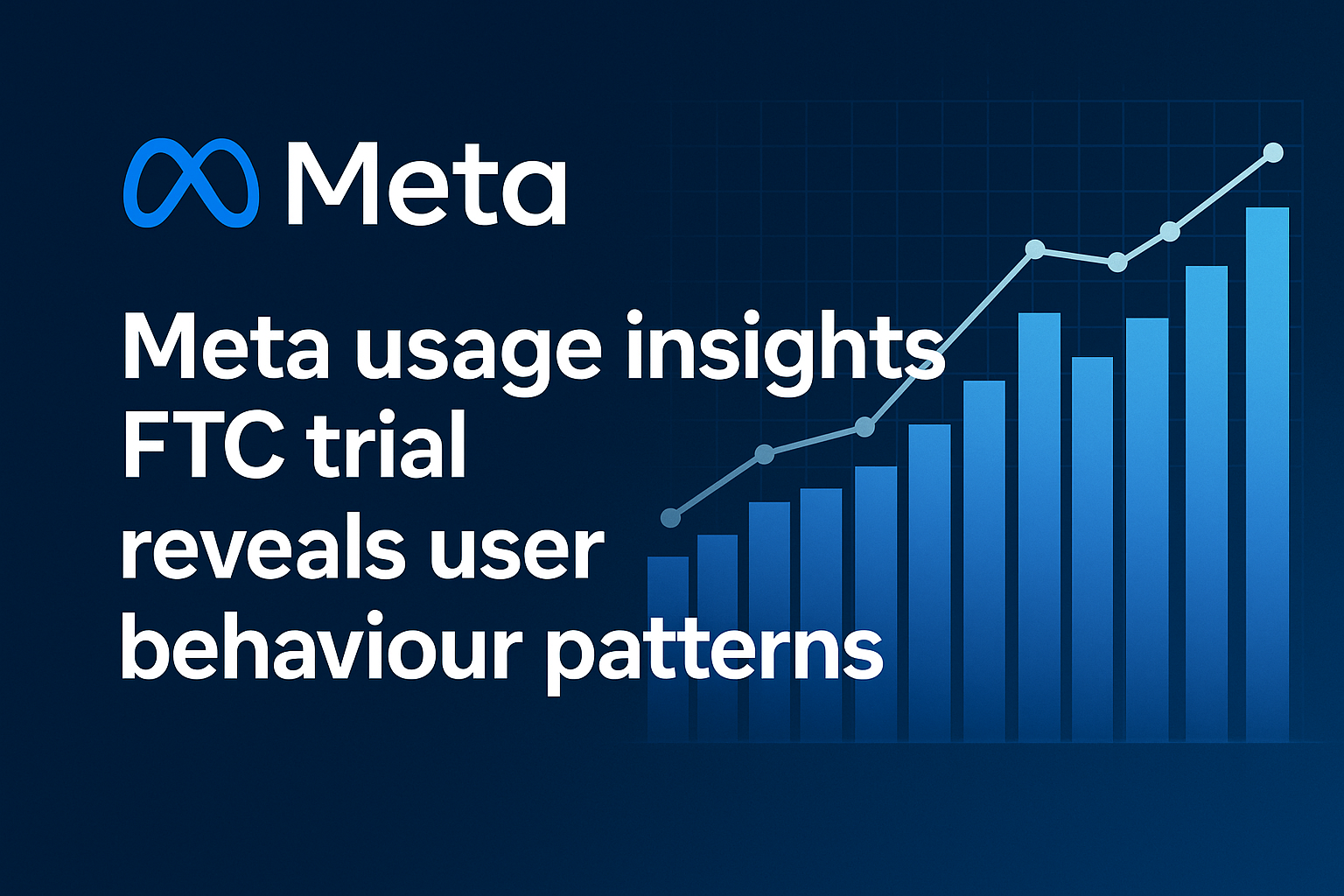
The most significant revelation from the Meta usage insights FTC trial was the breakdown of time users spend on each of Meta’s platforms. In the United States, Facebook users average around 20.6 hours per month, while Instagram users log approximately 12 hours. In stark contrast, Threads—the company’s answer to X (formerly Twitter)—clocks in at just 3 minutes per user per month. For businesses, this disparity in engagement time is critical. It clearly indicates where audience attention lies and where advertising investments are most likely to pay off. Facebook remains the workhorse of engagement, drawing users in for long periods and maintaining their attention, while Instagram continues to thrive as a visual-first platform for lifestyle and aspirational content. Threads, meanwhile, appears to be struggling to gain meaningful traction.
The Meta usage insights FTC trial also uncovered data related to user retention and repeated engagement, commonly referred to in the industry as “stickiness.” Facebook and Instagram demonstrate exceptionally high stickiness rates, meaning users return frequently and engage consistently. This stickiness suggests a habitual usage pattern, where Meta’s platforms are embedded into users’ daily routines. Businesses that produce regular, engaging content are more likely to benefit from this consistent user presence. These platforms aren’t visited occasionally—they are deeply entrenched in everyday habits. This provides fertile ground for ongoing campaigns, retargeting strategies, and brand-building efforts that rely on sustained user exposure.
One of the more compelling comparisons from the Meta usage insights FTC trial was the performance of Meta platforms against their rivals. TikTok, despite being seen as a dominant force among younger users, only garnered around 9 hours per month per user in the US. While this figure surpasses Instagram, it still falls significantly short of Facebook. Snapchat, another competitor, remains even further behind. This comparative data dispels myths that newer platforms are automatically superior for engagement. Instead, it suggests a balanced approach: businesses should continue to allocate a healthy share of their budget to Facebook and Instagram, where dwell time is proven and consistent. TikTok and Snapchat may play a role, particularly with Gen Z, but they should complement rather than replace Meta’s platforms in most digital marketing strategies.
The Meta usage insights FTC trial also shed light on how Meta evaluates its products internally. Threads was categorised as “early-stage,” confirming what many suspected: that the platform is still in its infancy and not yet ready for mass user adoption or significant business investment. This internal classification serves as a caution to marketers eager to jump on new platforms prematurely. Businesses should instead double down on the platforms with clear data demonstrating user engagement and retention. Facebook and Instagram continue to offer the best returns on time, money, and creative effort. Until Threads gains more meaningful engagement metrics, it should not be a central pillar of a business’s social media strategy.
Demographic breakdowns released during the Meta usage insights FTC trial provide additional clarity for marketers aiming to fine-tune audience targeting. Instagram remains dominant among users aged 18 to 34, particularly among women, while Facebook holds a broader demographic spread, including a stronghold among users aged 35 and older. Understanding this division is vital when developing tailored messaging. Content that performs well on Instagram—short videos, aspirational imagery, and influencer collaborations—may fall flat on Facebook, where users prefer informational content, community discussions, and direct calls to action. The trial’s findings reinforce the need for businesses to design channel-specific content rather than taking a one-size-fits-all approach.
The Meta usage insights FTC trial further highlighted the extent of Meta’s data collection and behavioural tracking capabilities. The company gathers data not only from its own platforms but also from users’ browsing activity and third-party sites via tools like the Facebook Pixel. For businesses, this means ad targeting on Meta’s platforms is underpinned by a vast, highly accurate behavioural database. When used correctly, this gives businesses a precision marketing tool with few rivals. However, to fully benefit, business users must ensure they are properly integrating Meta’s tracking tools into their websites, online shops, and CRM systems. These integrations enable accurate retargeting, conversion tracking, and the building of custom audiences that match real customer behaviour.
Another valuable takeaway from the Meta usage insights FTC trial was Meta’s strategic intent. While the company invests heavily in emerging technologies and platforms, it continues to rely on Facebook and Instagram as its revenue engines. This is evident in the trial’s evidence showing high ad engagement and return on investment from these platforms. Businesses should align their strategies accordingly. While it’s tempting to chase new and trendy platforms, the data shows that stability, reach, and user attention are still very much with Meta’s core apps. Ensuring that content and advertising efforts are focused where the majority of user attention lies is not just logical—it’s essential for a strong digital ROI.
The trial also revealed how much Meta values time spent on its platforms as a success metric. It’s not just about user numbers—it’s about how long users stay. The longer the dwell time, the more ads can be served, and the more chances businesses have to connect. This insight underscores the need for content that captures and holds attention. Whether it’s through storytelling, visual branding, or interactive experiences, businesses must focus on increasing the time users spend engaging with their content. Meta’s algorithms reward this kind of content with greater visibility and reach. The better your content performs in terms of engagement duration, the more likely it is to be surfaced to new audiences organically.
Equally noteworthy from the Meta usage insights FTC trial were insights into cultural and behavioural shifts that Meta monitors across its user base. These include trends in content consumption, sentiment analysis, and shifts in topical interests. For businesses, this is a reminder that social media strategy must be dynamic. What worked six months ago may no longer resonate today. Keeping abreast of evolving user interests, informed by Meta’s own data and wider societal trends, is key to maintaining relevance. Businesses that adapt quickly, test regularly, and iterate based on real engagement metrics will outperform those that rely on static content calendars or unchanging strategies.
The Meta usage insights FTC trial also affirmed that Meta platforms are deeply integrated into public discourse and community-building. From sharing news and expressing opinions to participating in group discussions, users engage with Meta not just for entertainment or product discovery, but also for social and political dialogue. For businesses, this presents both an opportunity and a responsibility. It’s important to consider the broader cultural context in which your content appears. Aligning with social values, demonstrating corporate responsibility, and avoiding tone-deaf messaging are crucial in a landscape where brand perception can shift rapidly.
Finally, one of the most enduring lessons from the Meta usage insights FTC trial is that data remains the bedrock of Meta’s operation. Every scroll, click, and pause is measured, analysed, and monetised. Businesses operating on Meta’s platforms must embrace this data-first reality. The most successful companies don’t just post content—they analyse its performance meticulously, test variables, and constantly optimise based on hard metrics. Meta provides a wealth of tools in Business Suite, Ads Manager, and Audience Insights. These tools are only as powerful as the effort businesses put into using them. Regular analysis and strategic refinement are not optional—they are the cost of admission in today’s social media landscape.
In conclusion, the Meta usage insights FTC trial offers more than just a peek behind the curtain. It provides a blueprint for how businesses should approach their presence on Facebook, Instagram, and, to a lesser extent, Threads. With average user time, demographic preferences, engagement patterns, and platform comparisons laid bare, the evidence makes a compelling case for businesses to continue prioritising Meta as a key digital marketing channel. The path to success is clear: produce engaging content, invest in advertising wisely, leverage Meta’s data tools, and adapt quickly to changes in user behaviour. In doing so, businesses can maximise their visibility, drive better engagement, and achieve superior returns in a landscape shaped by the very insights revealed through this landmark FTC trial.