Meta Restructures AI Division to Accelerate Innovation and Compete with Rivals
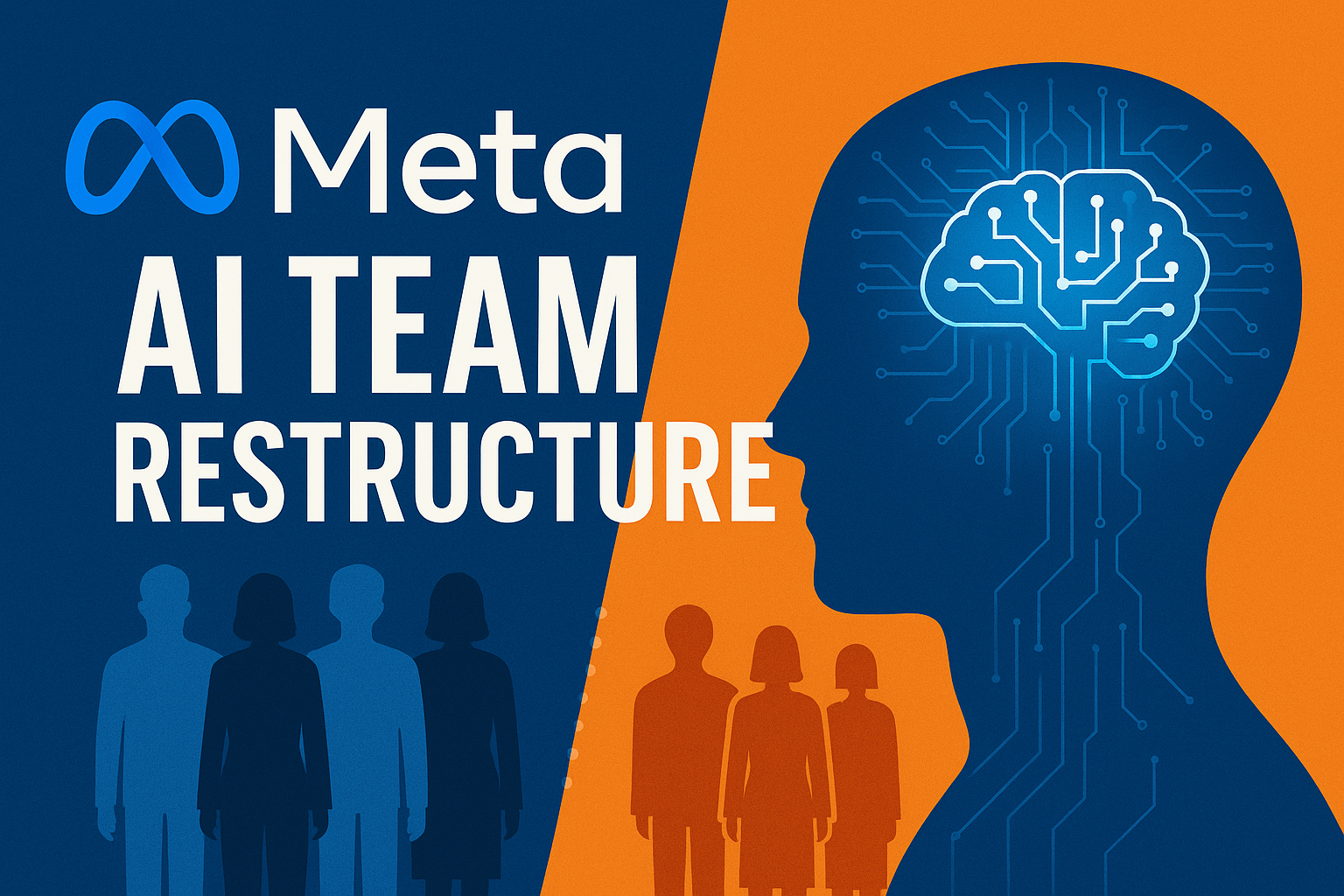
The Meta AI team restructure marks a pivotal moment in the company’s strategy to keep pace with leading rivals such as Google and OpenAI. As AI technologies evolve at an unprecedented rate, Meta is taking decisive action by overhauling its internal structure, splitting its artificial intelligence division into two specialised units. This move is designed to expedite development cycles and streamline focus, allowing Meta to innovate faster and more efficiently in a landscape where agility and technical excellence are paramount.
The newly formed AI Products team, headed by Connor Hayes, is tasked with integrating cutting-edge AI capabilities into Meta’s suite of consumer platforms, including Facebook, WhatsApp, Instagram and the Meta AI standalone application. This team will focus on user-facing features such as the Meta AI assistant and content generation tools housed in the AI Studio, reflecting the company’s intent to enhance everyday digital experiences through smarter automation and more intuitive services.
Meanwhile, the AGI Foundations team, under the joint leadership of Ahmad Al-Dahle and Amir Frenkel, will concentrate on longer-term research into artificial general intelligence. Their work will underpin future generations of Meta’s Llama model series and drive core advances in reasoning, multi-modal inputs, and voice synthesis. By carving out this distinct research stream, the Meta AI team restructure seeks to remove interdependencies that previously slowed progress, thereby fostering a more nimble approach to both product deployment and foundational breakthroughs.
This restructuring is not merely administrative—it is a response to growing pressures inside and outside the company. Internally, Meta has experienced significant turnover within its AI workforce, particularly among researchers involved in the Llama project. Many have departed for startups or competing giants, raising concerns about Meta’s ability to retain top talent. Of the 14 original contributors to the landmark 2023 Llama paper, only three remain at Meta. Such attrition could impact the quality and delivery of future models if left unaddressed, making the need for clarity and leadership in the AI division all the more critical.
In parallel, Meta is taking steps to improve performance management company-wide. New HR directives now require managers of larger teams to rank 15–20% of employees as underperformers during mid-year reviews, up from a previous threshold of 12–15%. While controversial, this policy aims to raise the bar internally, ensuring that only the most capable contributors are driving the company’s next generation of AI tools.
These changes arrive as competitors make major advances. OpenAI’s GPT-4.5 and Google’s Gemini 1.5 Pro have shifted industry benchmarks and consumer expectations alike. Against this backdrop, the Meta AI team restructure aims to sharpen focus on both short-term usability and long-term capability, allowing Meta to reclaim its stake in the AI arms race.
Investment is also a cornerstone of Meta’s AI resurgence. The company plans to allocate up to $65 billion to AI infrastructure in the current financial year. This expenditure supports a range of initiatives, from server hardware upgrades to experimental projects such as AI-enhanced humanoid robots under the Reality Labs division. Another key development is the standalone Meta AI app, expected to launch imminently with premium subscription tiers and more advanced features than those currently integrated into Meta’s social platforms.
To lead the revitalised research direction, Meta has reappointed Robert Fergus—an AI pioneer and former Google DeepMind executive—to helm its FAIR (Fundamental AI Research) lab. Fergus, who co-founded FAIR with AI luminary Yann LeCun in 2014, returns to help push the boundaries of synthetic audio, robotics, and other advanced domains where Meta seeks to regain leadership.
Still, numerous challenges remain. The delayed rollout of the anticipated Llama 4 model and internal dissatisfaction over model quality have cast doubt on the company’s ability to execute on its ambitious roadmap. Coupled with ongoing staff attrition, Meta must now demonstrate that its structural changes will translate into tangible technical advances. The success of the Meta AI team restructure hinges on the company’s ability to foster a more dynamic, goal-oriented environment that not only retains top-tier researchers but empowers them to deliver transformative results.
Looking ahead, the restructure could also have a profound impact on how Meta deploys AI across its broader ecosystem. Beyond consumer-facing applications, AI is expected to play an increasingly central role in Meta’s advertising algorithms, recommendation engines, and business analytics tools. A more capable AI division could help refine ad targeting, increase personalisation, and unlock new monetisation models for Meta’s clients and partners.
This potential goes beyond just revenue. If successful, the Meta AI team restructure could position the company as a pioneer in enterprise AI applications, expanding its influence beyond social media into productivity, collaboration, and automation sectors. For business users, this could result in more sophisticated tools for content generation, customer engagement, and campaign analysis—features that are becoming essential in the digital economy.
Moreover, Meta is expected to expand the reach of its AI assistant far beyond text prompts. Voice interfaces, real-time document creation, and multi-language translation are all on the horizon, powered by improved reasoning and context-awareness. By consolidating short-term execution with long-term vision, the new structure offers a strategic blueprint for sustainable AI leadership.
While industry observers remain cautiously optimistic, the coming months will be crucial. The true test lies not in the reorganisation itself but in the quality of outcomes it enables. If the Meta AI team restructure results in faster releases, better-performing models, and greater user adoption, it will likely be hailed as a masterstroke. However, should progress stall, the move risks being viewed as a superficial fix to deeper operational inefficiencies.
In conclusion, the Meta AI team restructure represents more than a change in reporting lines—it is a calculated effort to reset Meta’s approach to artificial intelligence. By splitting responsibilities between consumer products and AGI research, the company is seeking to reclaim a leadership position in a field that is rapidly reshaping global technology. With fresh leadership, significant funding, and a clarified vision, Meta has the components in place to succeed. But whether it can execute this plan effectively remains to be seen. For now, all eyes are on how this restructure translates into real-world impact—for users, for businesses, and for the future of AI.