Meta AI Video Editing Transforms Instagram Video Restyling and Creative Content Production for Businesses
Meta AI video editing is set to reshape how businesses create, enhance, and restyle their Instagram content in ways that traditional editing tools simply cannot match. As Meta continues to position itself at the forefront of social media innovation, the introduction of advanced AI-driven video editing features for Instagram presents both opportunities and challenges for businesses aiming to capture attention and engagement in an increasingly crowded digital space. These tools promise to lower production barriers while amplifying creative possibilities, allowing small businesses and established brands alike to produce professional-grade content with minimal technical expertise. The latest updates signal that Meta is deeply invested in empowering users—particularly business accounts—to leverage artificial intelligence as a core element of their content strategies.
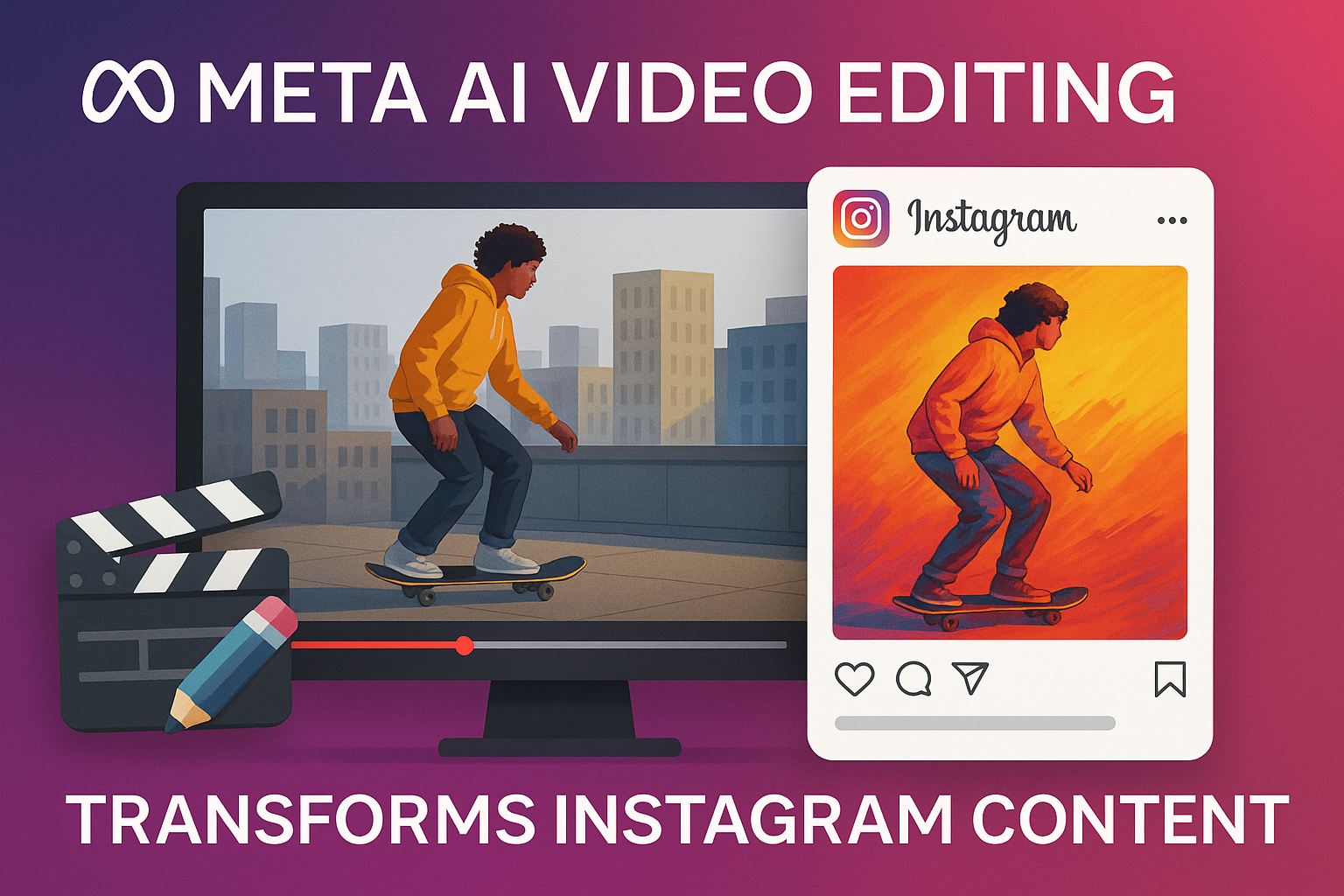
At the heart of this development lies Meta AI video editing technology, which integrates directly with Instagram’s in-app editing suite. This is significant because it allows users to transform and restyle existing video content with unprecedented ease. Rather than relying on external apps or professional video software, brands can now manipulate their visual media using AI tools that automate the labour-intensive processes of trimming, colour grading, and thematic restyling. These features promise to cut production time dramatically while maintaining or even enhancing the aesthetic quality of output, which is crucial in today’s high-speed content economy. For business users, this means quicker turnarounds, more agile marketing campaigns, and content that looks polished without requiring a dedicated media team.
Moreover, Meta AI video editing introduces a level of creativity that was once the domain of specialists. One of the most compelling aspects of the update is its capacity for ‘video restyling’—the ability to reimagine the visual appearance of clips by applying AI-generated themes or moods. This can include shifting the colour palette, altering textures, and adding visual effects that complement the intended message of the content. Brands seeking to stay on-trend or align with seasonal aesthetics can now do so without outsourcing to costly creative agencies. The implications for small businesses are particularly profound; entrepreneurs, influencers, and niche service providers can access high-quality content customisation at scale, thus levelling the playing field against larger, resource-rich competitors.
The technical innovation behind Meta AI video editing reflects the company’s broader ambition to weave artificial intelligence into every layer of its platform architecture. By using machine learning models trained on vast datasets of visual media, these editing tools ‘understand’ composition, lighting, and even narrative flow to make intelligent suggestions or automated changes. This capability allows business users to experiment with different creative directions without the usual risk of wasting time or resources. Whether reformatting a promotional video for a new demographic or adjusting the vibe of content to suit a cultural moment, the process becomes faster, more intuitive, and more aligned with evolving customer expectations. For businesses that depend on fast-moving social media trends, this shift could mark a turning point in their content strategy.
Another noteworthy aspect of Meta AI video editing is its seamless integration with Instagram’s user interface. Unlike previous updates where new features felt bolted on or inaccessible to casual users, this rollout emphasises ease of use. Business owners who may lack a background in media production can easily explore these advanced features without needing technical training. The intuitive design encourages experimentation, allowing brands to test multiple restyling options before settling on a final version. This fosters creativity and supports A/B testing of visual content—a valuable strategy for marketers seeking to optimise post performance based on audience engagement data.
In addition to creative advantages, Meta AI video editing offers practical benefits in terms of efficiency and scalability. Content creation has long been a bottleneck for small and medium enterprises seeking to maintain an active presence on Instagram. Hiring videographers or purchasing expensive software has traditionally been the only path to producing quality visuals that resonate with modern audiences. Now, thanks to AI-powered automation, even one-person businesses can produce attractive, high-quality videos tailored to their brand identity. This is especially important in markets where visual storytelling drives customer decision-making, such as fashion, beauty, food, travel, and fitness. As Meta AI video editing evolves, its capacity to generate consistent and compelling content on-demand may well redefine what it means to run a cost-effective and competitive social media operation.
There is also the issue of customisation, which Meta AI video editing addresses in a sophisticated manner. Instead of merely offering generic filters or effects, the tool allows for fine-tuned control over how restyling is applied. This means brands can maintain visual consistency across posts, aligning every video with their established identity. For example, a luxury fashion label can ensure that colour treatments remain muted and elegant, while a sports brand can apply dynamic, high-energy styles that reflect its target audience’s preferences. Such granular control is essential in maintaining brand integrity and preventing audience confusion—an often-overlooked risk when using automated creative tools.
From an SEO and discovery standpoint, Meta AI video editing indirectly boosts visibility potential. Videos that are professionally styled and aesthetically engaging are more likely to attract interactions, including likes, shares, and saves. This engagement activity feeds into Instagram’s recommendation algorithms, increasing the likelihood that content will appear on Explore pages or in suggested feeds. Business accounts utilising these AI features may therefore enjoy improved organic reach—an increasingly valuable commodity as advertising costs rise. While Meta has not explicitly linked its AI editing tools to platform ranking factors, the correlation between content quality and audience exposure is well established in social media marketing literature.
Privacy and data handling remain concerns in any AI-driven innovation, and Meta AI video editing is no exception. However, initial reports suggest that video content processed via these tools does not result in additional data collection beyond existing platform norms. This is crucial for businesses operating under strict data compliance regimes, such as GDPR in Europe. Meta’s ongoing focus on responsible AI deployment may help reassure enterprise users that adopting these features will not expose them to regulatory risk. Nonetheless, businesses should remain vigilant and review updates to platform policies as AI editing capabilities expand.
Another point worth considering is how Meta AI video editing could shift user expectations for video content quality. As more accounts adopt these tools, audiences may come to view polished, stylised videos as the new standard on Instagram. This raises the bar for all content creators, including businesses, who must either match this quality or risk appearing outdated or amateurish. While the new tools lower the barrier to entry, they also increase the competitive pressure to use them well. Brands that fail to embrace these innovations may find themselves marginalised as audiences gravitate towards richer, more visually satisfying content produced by their peers or rivals.
Critically, the introduction of Meta AI video editing marks a broader trend in the social media landscape towards democratised creativity. Platforms like TikTok and Snapchat have long offered filters and effects to casual users, but Meta’s move represents the most substantial effort yet to provide professional-grade AI editing directly within a mainstream app. For business users, this is a double-edged sword: while the technology unlocks powerful new possibilities, it also means that competitors—large and small—can access the same tools. Differentiation will therefore depend not only on using the technology but on using it strategically and creatively to tell unique brand stories that resonate with target audiences.
Looking ahead, the roadmap for Meta AI video editing appears promising. Industry analysts speculate that future iterations may include features like AI-generated voiceovers, automatic captioning in multiple languages, and even generative video creation from text prompts. Such capabilities would further reduce the need for specialist staff, enabling businesses to produce multilingual, globally relevant content with minimal effort. This aligns with Meta’s metaverse ambitions, where rich, dynamic media creation will be a cornerstone of user experience. Businesses investing time now in mastering these tools may gain a crucial head start as the ecosystem evolves.
Of course, challenges remain. The reliance on AI introduces a risk of homogenisation, where too many brands produce similarly styled content, leading to audience fatigue. To counter this, businesses must balance automation with originality, ensuring that AI-generated effects enhance rather than replace authentic brand expression. Moreover, companies will need to monitor how these tools impact performance metrics such as engagement rates, follower growth, and conversion effectiveness. Without rigorous analysis, the benefits of Meta AI video editing may be squandered through unfocused or indiscriminate use.
In conclusion, Meta AI video editing represents a significant leap forward for Instagram content creation, offering transformative benefits to business users of all sizes. By streamlining production processes, enhancing creative flexibility, and lowering technical barriers, these tools empower brands to engage audiences with visually compelling stories. However, success will depend not merely on adoption but on thoughtful, brand-aligned application of the technology. As Meta AI video editing continues to evolve, businesses that leverage its full potential while maintaining authenticity and strategic clarity are likely to outpace competitors in the increasingly visual world of social media marketing. For companies serious about building a durable Instagram presence, mastering this new wave of AI-driven creativity is no longer optional—it is essential.