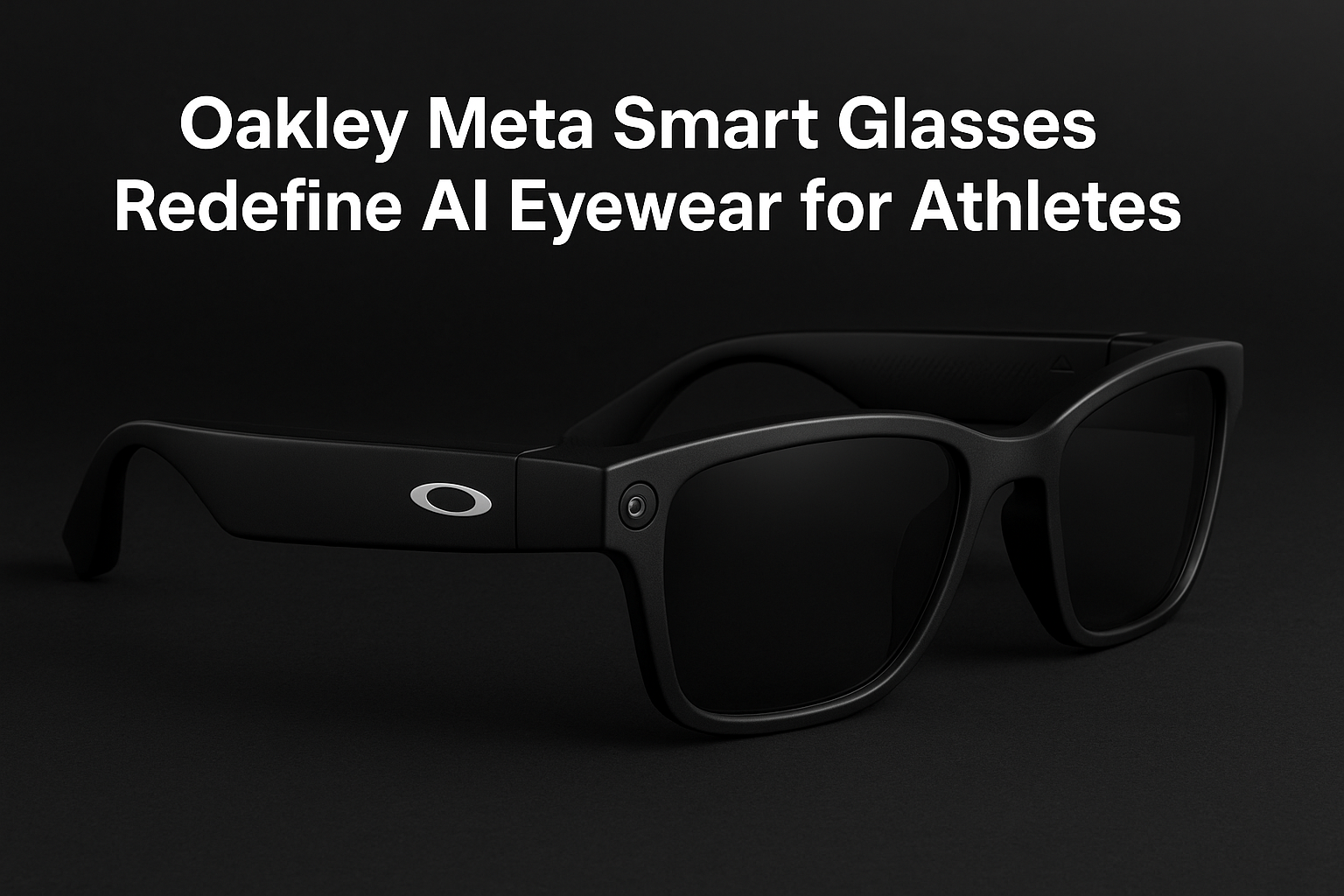
Oakley Meta Smart Glasses Redefine AI Eyewear for Athletes
Meta has taken a significant leap forward in the wearables space with the introduction of Oakley Meta smart glasses—a pioneering fusion of cutting-edge artificial intelligence, performance eyewear, and real-world utility. Aimed at elite athletes, creators, and tech-forward consumers, these glasses are more than just another product—they represent a new category entirely, one that brings Meta’s AI to the forefront of sport and performance. Co-developed with EssilorLuxottica and launched under the prestigious Oakley brand, this innovation blends Meta’s generative AI with Oakley’s proven heritage in high-performance eyewear.
At first glance, the Oakley Meta smart glasses look every bit the part of Oakley’s sporty DNA: bold frames, precision design, and built with durability in mind. But embedded within the familiar exterior lies an advanced system of spatial computing, camera technology, and voice-interaction AI that transforms these glasses into an entirely new kind of interface. With these glasses, athletes and users don’t just see the world—they interact with it in intelligent, augmented ways.
One of the major differentiators of the Oakley Meta smart glasses is how they redefine hands-free control. Rather than relying on touchscreens or physical input, these glasses are powered by voice commands and Meta AI’s spatial understanding. This allows athletes, for example, to get real-time feedback, log their progress, and even live-stream their activity without ever breaking stride or focus. The glasses also boast an impressive 12-megapixel camera that allows users to capture high-quality photos and videos with voice prompts. Whether someone’s cycling across winding terrain or sprinting across a track, they can document their performance effortlessly and instantly.
Meta’s emphasis on user experience is clear in how the AI is tailored for movement. Unlike typical smart glasses, which often prioritise visual overlays or notifications, Oakley Meta smart glasses focus on context-aware intelligence. For example, when a cyclist says, “Take a photo of the view,” the glasses understand where the cyclist is facing and captures it with spatial precision. This level of nuanced interaction indicates a thoughtful evolution in AI eyewear, one where intelligence is truly embedded in the moment-to-moment experiences of the user.
For creators, the glasses offer a portable, wearable studio. With just a few words, content can be captured, saved, and shared. The AI assistant helps suggest captions, identifies notable moments, and allows quick uploads to platforms—perfect for those who live and work in a fast-paced digital content ecosystem. Oakley Meta smart glasses remove the friction from content creation, replacing phones and action cameras with an integrated, discreet tool that doesn’t interrupt the user’s flow or performance.
From a technical standpoint, these glasses feature Qualcomm’s AR1 Gen 1 Platform, which enables ultra-efficient processing power in a compact format. Meta has clearly prioritised performance and battery optimisation, ensuring that the device supports prolonged use without bulkiness or overheating—two common complaints among early adopters of wearable tech. With a charging case that provides up to 36 hours of use, the glasses are clearly built for endurance.
The Oakley Meta smart glasses also include open-ear audio technology. This allows users to listen to music, get updates from their AI assistant, or even take calls without blocking ambient sounds—a crucial feature for athletes who need to stay aware of their surroundings. The audio system is powered by custom-designed speakers that adapt dynamically to external noise conditions. So whether one is cycling in the city or training in a windy stadium, audio clarity remains consistent and immersive.
The collaboration with Oakley is not just a branding exercise; it brings a performance-first lens to smart glasses that have traditionally leaned towards novelty or casual use. Oakley’s long-standing association with professional athletes, extreme sports, and Olympic-level gear elevates the credibility of this launch. These aren’t just glasses with tech—they’re performance gear augmented by technology. For Meta, aligning with Oakley ensures that the glasses are seen as essential equipment rather than optional accessories.
Meta is also piloting these glasses with high-profile athletes, including WNBA stars and elite runners, as part of a feedback loop designed to refine the product in real-world environments. This kind of embedded testing is crucial to ensuring that the glasses aren’t just impressive on paper, but genuinely useful in practice. Feedback from these early users is already shaping future iterations of both hardware and software, with Meta’s AI learning from real-world application and enhancing its contextual accuracy over time.
The glasses are part of Meta’s broader vision to embed AI into everyday interactions—not just through smartphones and computers, but through tools that people already wear and rely on. With Oakley Meta smart glasses, Meta is pushing the boundaries of what wearable AI can do, moving from passive data collection and notification delivery to a more symbiotic relationship between user and device.
This shift also signals a growing divergence between Meta’s approach to AI and that of its competitors. Where others are focusing on AR overlays or standalone devices, Meta is integrating intelligence into familiar form factors and routines. This subtlety may well be the winning factor. Instead of asking users to adapt to a new device, Meta is embedding intelligence into tools that already make sense within their lifestyles.
Privacy and safety are also clearly top priorities. All data interactions are encrypted, and the AI assistant is designed with user control in mind. Users can opt in or out of various functionalities, control when the camera is active, and even delete recordings or interactions on command. Meta has also integrated visible LED indicators to ensure that those around the wearer know when recording is active—addressing one of the most common public concerns about wearable cameras.
For businesses, particularly those involved in sports training, content creation, or live event broadcasting, the Oakley Meta smart glasses represent a compelling proposition. Imagine coaches being able to view an athlete’s performance from their perspective in real-time, or content creators capturing footage from eye-level during an action-packed experience. There’s potential here not only for individual use but for professional and enterprise integration as well.
Additionally, as Meta refines its AI capabilities, it’s likely that the Oakley Meta smart glasses will become more personalised. Future updates may allow users to teach the assistant preferred routines, phrases, or workflows. The glasses could become an adaptive partner, learning over time how best to support the user’s goals, whether that’s running faster laps, producing better content, or simply navigating the day with more ease.
All of this reinforces the idea that Oakley Meta smart glasses are not a gimmick. They’re a serious piece of performance tech, designed for people who expect more from their gear. They mark a turning point in how AI is applied to everyday life—less as a novelty and more as a utility that enhances rather than interrupts.
In the end, what Meta has achieved with these glasses is not just a product launch, but a signal of intent. By combining its formidable AI ecosystem with Oakley’s athletic credibility, Meta is asserting itself at the forefront of wearable intelligence. It’s a bold move that will likely influence how other companies approach the integration of AI into lifestyle and performance products in the years to come.
The Oakley Meta smart glasses are currently available in select markets, with wider availability expected as Meta continues to scale production. While pricing may place them in the premium tier, the value proposition—especially for athletes and creators—justifies the investment. These glasses are not for everyone, but for those who need speed, precision, and intelligence in their eyewear, they may very well become indispensable.
As AI and wearable tech continue to converge, Oakley Meta smart glasses are a strong indication of where the future is heading: towards devices that don’t just respond to you, but anticipate, enhance, and evolve with you. For business users, creators, and elite performers, this may be the smartest way yet to see—and shape—the world around them.