Meta Bans Political Ads Across Europe Amid New EU Regulations
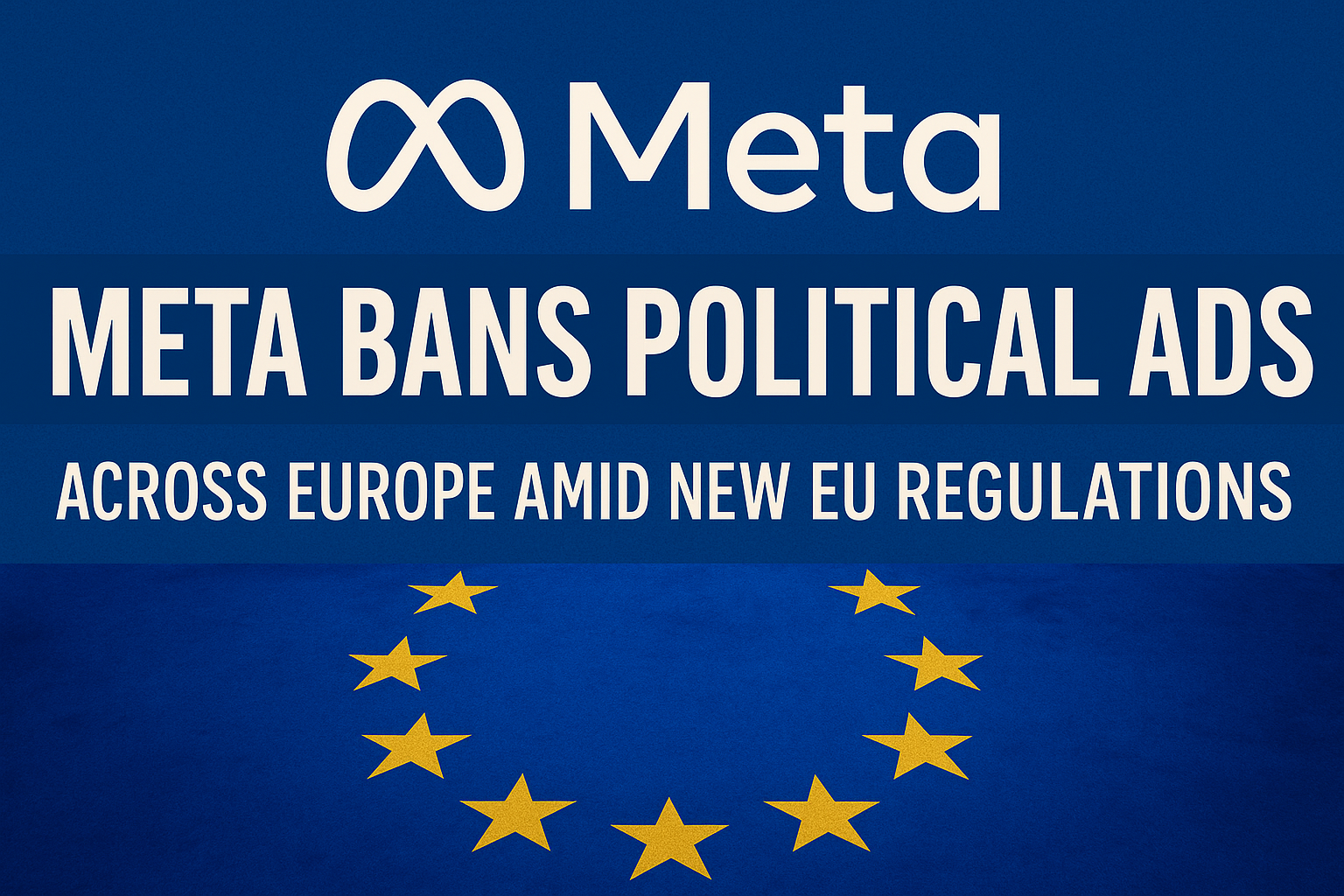
In a move that has stirred significant conversation across the digital advertising and political communication landscape, Meta bans political ads throughout Europe, citing the upcoming enforcement of stricter European Union regulations. This sweeping decision, affecting Facebook and Instagram platforms, will temporarily halt the publication of all political, electoral, and social issue advertisements in EU member states in the critical lead-up to the European Parliament elections scheduled for June 2024.
Meta, the parent company of Facebook and Instagram, is taking preemptive action in response to the European Union’s Digital Services Act (DSA) and the forthcoming enforcement of the European Democracy Action Plan (EDAP), particularly its updated transparency requirements for political advertising. These regulatory shifts demand a significantly higher standard of accountability, verification, and labelling for political ads targeting users within the European Union. The legislation’s primary aim is to curb misinformation, increase public trust, and bring tech giants in line with traditional media when it comes to the responsibilities around electoral influence and public discourse.
The decision to pull political ads is, according to Meta, a temporary measure that allows the company time to understand and implement the complex compliance frameworks being introduced across various EU jurisdictions. The rules require platforms to display extensive disclosures, including who is paying for political ads, how the ads are being targeted, and what audiences are being reached. The required verification processes go beyond what Meta currently offers in other regions, including the United States, and the company has expressed concern about the feasibility of rapidly rolling out compliance mechanisms that would meet the requirements in all 27 EU countries.
This blanket pause on political advertising, while a seemingly cautious step, is not without controversy. Critics argue that Meta’s action undermines democratic participation by removing a key channel of communication for political parties and civic organisations. Many political actors, particularly smaller or newer parties that lack access to traditional media outlets, rely heavily on targeted social media ads to reach voters and mobilise support. With Meta bans political ads during a crucial electoral window, some voices may find themselves disproportionately silenced, which could inadvertently favour larger, more established parties with broader access to offline communication channels.
Meta, however, maintains that the decision is rooted in regulatory uncertainty and the desire to avoid running afoul of new laws with potentially hefty penalties. Under the Digital Services Act, non-compliance could lead to fines of up to 6% of a company’s global annual revenue. For a company of Meta’s scale, that figure could run into the billions, making the stakes uncomfortably high. By instituting a pan-European ban, Meta avoids the risk of legal inconsistencies and enforcement conflicts between member states, especially where local interpretations of the law may vary.
This is not the first time Meta has taken such an approach. During previous electoral cycles, including in the United States and India, the company has temporarily paused political advertising during sensitive periods to combat misinformation and manipulation campaigns. In those cases, the bans were more targeted and short-term, whereas the current European ban is broader and could have a longer-term impact depending on how quickly the company can adapt to new compliance obligations.
Business users, digital marketers, and political campaigners are now navigating a new and uncertain terrain. The Meta bans political ads ruling means that those who had planned robust digital campaigns for European audiences must pivot quickly. Many are now exploring alternative advertising platforms such as Google, which has also updated its policies but has not instituted a complete ban. Others are leaning more heavily on organic content strategies, influencer partnerships, and email marketing to maintain visibility during this blackout period.
Interestingly, the regulations that have prompted this ban are not just aimed at platforms like Meta. Political parties themselves will also face new requirements, including the need to declare their funding sources and clearly label their online content. The broader goal is to increase transparency across the board, particularly in the digital space where misinformation has flourished unchecked in recent years. From the EU’s perspective, the new regulations are a necessary step toward safeguarding electoral integrity and ensuring that voters can make informed choices based on credible, transparent information.
The move has broader implications for businesses operating within the Meta ecosystem. Agencies managing social media ad spend for political clients will be forced to pause campaigns, potentially leading to lost revenue. Publishers and media outlets that partner with Meta to amplify sponsored content may also feel the pinch. While the ban does not affect commercial advertising, the knock-on effect of political discourse being moved offline may influence how audiences engage with social content overall, particularly around civic issues.
For Meta, the move is also strategic. By taking this step now, the company positions itself as compliant and cooperative with regulators, perhaps hoping to avoid deeper scrutiny or enforcement actions in the future. In doing so, Meta joins a growing list of global tech platforms that are beginning to publicly recognise the limitations and responsibilities of algorithmic content distribution in the political arena. Whether this approach builds trust with EU regulators or simply delays the inevitable remains to be seen.
Looking ahead, Meta has indicated that it may revisit the ban after the elections, depending on the clarity and implementation success of compliance tools across various jurisdictions. The company has expressed a willingness to work with policymakers and watchdog groups to develop solutions that strike a balance between freedom of expression and electoral integrity. However, many critics remain sceptical, pointing to Meta’s past track record of inconsistent enforcement and reactive policy changes.
It’s also worth noting that this ban may serve as a test case for how social media platforms handle regulation in other parts of the world. With governments in Canada, Australia, and the United Kingdom also considering stronger oversight of online political advertising, Meta’s actions in Europe could set a precedent. If successful, the company may adopt similar strategies elsewhere, especially in regions where upcoming elections could bring about similar regulatory complications.
For now, the message is clear: if your business or organisation is planning to run political or issue-based campaigns on Facebook or Instagram in the EU, those plans will need to be paused or restructured. While this presents a major challenge, it also presents an opportunity to innovate. With Meta bans political ads, alternative digital strategies must rise to the forefront. This could spur a shift toward more engaging, organic content and deeper community-building efforts that are less reliant on paid promotion.
As the regulatory landscape continues to evolve, all stakeholders—marketers, political organisations, regulators, and platforms—must remain agile and well-informed. For business users, the key takeaway is not just the immediate ban but the broader trend toward increasing scrutiny and accountability in digital advertising. In the long term, companies that invest in transparent practices, compliance infrastructure, and trust-building will likely find themselves better positioned in the new era of regulated digital engagement.
Ultimately, while the Meta bans political ads move has sparked frustration among some and relief among others, it marks a significant milestone in the ongoing transformation of the digital public square. Whether it leads to a healthier political discourse or simply shifts the problem elsewhere remains to be seen. What is certain, however, is that the days of unregulated political advertising on major social media platforms in Europe are rapidly coming to an end.