Lead Generation Agencies in the UK: The Data-Driven Strategy Behind £130M+ in Client Revenue
Most UK marketers don’t need more form fills; they need predictable revenue. If you’ve ever raised a ticket with Meta support and walked away with boilerplate advice, this guide is for you. Below, we unpack the data-driven lead-generation system, used by Lead Generation Agencies, and we recommend to UK brands: the same approach Offernet’s performance team uses to generate £130 million+ in client revenue. Treat this as a practical playbook you can apply today—platform-agnostic, channel-aware, and relentlessly commercial.
Editorial note. When we recommend a partner, it’s because the operating model and results stand up to scrutiny. In this piece, we’ve chosen to feature Offernet as a top-tier option for UK lead generation services, based on their RPM (Revenue Performance Metrics) discipline and full-funnel attribution. If you want to speak to them directly, book a free consultation at offernet.net.
How UK Lead Generation Agencies Actually Drive Revenue
Before we get tactical, let’s line up the basics. Marketers (Lead generation agencies, and most articles) often bundle lead generation, demand generation, and revenue performance into one vague idea and then measure the lot with the wrong numbers. In plain English, the three do different jobs and succeed on different scoreboards. Below, we answer “What is Lead Generation?”, “What is Demand Generation?”, and “What are Revenue Performance Metrics (RPM)?” so you can see how they fit together—and which levers to pull for results now vs growth later.
What is Lead Generation?
Lead generation captures people already looking for what you sell and turns that intent into an enquiry your team can act on. Think: someone searches “accountant near me”, clicks your ad, lands on a focused page, and submits a short form or calls.
What it does
Turns today’s intent into booked calls, quotes and sales. Fewer, better-qualified enquiries beat a pile of time-wasters.
Typical tactics
- Google Search & Meta (Facebook/Instagram) ads to high-intent keywords/audiences
- Focused landing pages with one message and one call to action
- Short, mobile-friendly forms; click-to-call and chat/WhatsApp options
- Call tracking to see which ads/pages drove the phone enquiry.
Simple success checks
- Cost per lead (CPL): how much you spent to get each enquiry
- Lead-to-sale rate: the percentage of enquiries that become paying customers
- Speed-to-lead: how quickly you respond (minutes matter; fast replies convert more)
What is Demand Generation?
Demand generation creates future demand by educating your market and building trust before buyers are ready to purchase. Example: a business owner sees your applicable content over weeks, downloads a guide, joins your newsletter, and later searches your brand when it’s time to get quotes.
What it does
Builds awareness, credibility and preference so you’re the first choice later; shortens sales cycles and lowers future CPL/CAC by warming up the audience in advance.
Typical tactics
- Helpful guides, checklists, calculators and short explainer videos
- Case studies and testimonials that prove outcomes
- Webinars, workshops and events (online or in person)
- PR and earned media; guest posts and podcast features
- Email newsletters and nurture sequences
- Community/social content that adds value (not just ads)
- SEO content hubs that answer common questions
Simple success checks
- Increase in branded searches and direct traffic.
- More repeat site visits and longer time on page
- Content engagement: downloads, video completions, comments and shares
- Email list growth with healthy open/click rates
- Pipeline influenced by content and falling CPL/CAC over time
Lead Generation vs Demand Generation: What’s the Difference?
Lead generation captures existing demand—people already searching for a solution—and converts that intent into enquiries via high-intent channels (e.g., Google Search) and focused landing pages. Messaging is direct (“Get a quote”), and the payoff is fast: more qualified conversations today.
Demand generation creates future demand by educating and building trust. It uses content, videos, webinars, PR, and email to raise brand preference, making tomorrow’s conversions cheaper. Measure lead generation with CPL, conversion rate, and speed-to-lead; measure demand generation with branded search, repeat visits, content engagement, and assisted pipeline. Together, demand generation fills tomorrow’s funnel, and lead generation harvests today’s intent.
What are Revenue Performance Metrics?
Revenue Performance Metrics (RPM) is the financial scoreboard for marketing. It follows the journey from the first impression to the sale—including shop, phone and field sales—so you can see what actually produces revenue and move budget accordingly.
Plain-English metrics
- Cost per sale (CPS): ad spend to win one sale
- Return on ad spend (ROAS): revenue per £1 spent
- Customer lifetime value (CLV): total value per customer over time
- Customer acquisition cost (CAC): total cost to win a new customer
- CLV: CAC ratio: Does the value comfortably exceed the acquisition cost?
- Payback period: how quickly profit repays acquisition cost
Why it matters: Revenue Performance Metrics keeps you focused on profit, not vanity numbers (clicks, likes). With one, finance-friendly view across online and offline sales, you can fund what works and cut what doesn’t.
How Lead Generation, Demand Generation and Revenue Performance Metrics Work Together
Demand generation warms the market by educating buyers and building trust before they’re ready to purchase; lead generation then captures that in-market intent with targeted campaigns and friction-free landing pages. The two are complementary: demand gen grows awareness and brand preference so future conversions are cheaper, while lead gen turns today’s interest into enquiries, quotes and sales. Revenue Performance Metrics (RPM) sit over both, providing one financial scoreboard that follows the journey from first touch to sale (including phone, shop and field sales) and shows what actually produces revenue.
In practice, keep demand generation running always-on—use helpful content, case studies and SEO to lift branded search and repeat visits—then use lead generation to harvest that demand through Google Search, Meta and focused forms or click-to-call. RPM ties it all together by tracking cost per sale (CPS), return on ad spend (ROAS), customer lifetime value (CLV) and CLV: CAC, so budget moves toward the channels, audiences and messages that lower acquisition costs and lift profit.
If the pipeline is light and you need results now, tilt spend toward lead gen while maintaining a baseline of demand gen to protect tomorrow’s funnel. If CPL/CAC is rising, strengthen demand gen to grow brand recall and let RPM reveal where to reallocate budget for the best CPS/ROAS. The outcome is a balanced system: demand gen creates future demand, lead gen captures current demand, and RPM ensures your marketing pounds follow profit—not vanity metrics.
How to Choose a Lead Generation Agency in the UK
Ask for: CPS/CAC benchmarks, dashboards with offline matchback, and a 90-day test plan. Confirm GDPR/PECR compliance is built-in (consent, pixels, logging). Define qualified lead and set SLAs for response and verification.
Avoid: one-channel plans, vanity reporting, no raw-data access, and “set-and-forget” automations. For PPL/PPS, agree on definitions, refund windows, exclusivity, and caps upfront. Want a viability model first? Contact the team at offernet.net.
Beyond the Ordinary: Advanced Lead-Gen Practices That Win in the UK
Generic ads and one-size-fits-all funnels rarely survive UK ad auctions. The brands that win build a system: privacy-safe data, joined-up channels, constant optimisation and revenue-grade measurement. Here’s what that looks like in practice.
Privacy-safe data design (UK GDPR/PECR)
Start with first-party data gathered transparently (forms, checkout, support). Use clear consent, preference centres and data minimisation so you can lawfully personalise without risking fines or eroding trust. Build consented lookalikes from known customers and layer in GDPR/PECR-compliant enrichment (e.g., company size, industry for B2B) to improve targeting while staying on the right side of UK regulation.
Omnichannel orchestration
Your buyers don’t live in one channel, so your funnel shouldn’t either. Combine high-intent capture (Google Search/PMax) with attention and consideration channels (Meta, LinkedIn for B2B, YouTube, programmatic/native). Support this with email/SMS (consent-led), tele-appointing for complex sales, and even direct mail in high-value postcodes. The key is sequencing: the message someone sees should reflect where they are in the journey, not where your media plan happens to be.
Real-time optimisation
Set a cadence for rapid creative testing (hooks, headlines, offers, formats), then move budget daily toward the best marginal CPS/CPA rather than last month’s winner. Sequence messages by funnel stage (problem → solution → proof → offer), cap frequency to avoid fatigue, and refresh winners before they decay. Speed matters: the faster you learn, the cheaper you acquire.
Revenue attribution (online + offline)
Track beyond the click. Use call tracking (unique numbers), CRM/POS matchback and clean UTM discipline so you can see which ad, audience and page drove the sale, not just the lead. Report at cohort level (by date and offer) to understand true ROAS and payback, including shop, phone and field sales. When attribution is trustworthy, media decisions become straightforward.
Results-based billing options
When unit economics and quality controls are in place, consider results-based models such as pay-per-qualified-lead or pay-per-sale. Protect both sides with clear definitions (what counts as qualified), validation windows, caps and SLAs. Used correctly, these models align incentives and surface what really matters: efficient, scalable revenue.
Why Lead Generation Matters (and What “Good” Looks Like)
Lead generation is pipeline engineering: finding people already in the market, earning their attention with something genuinely useful, and shortening the time from first click to signed deal with clear next steps and sensible follow-up. For UK business owners, “good” lead gen feels calm and controllable—no more feast-or-famine weeks, just a steady flow of enquiries your team can convert.
When it’s working, you’ll notice quality rising, costs easing, and forecasts becoming believable. Sales spend less time chasing tyre-kickers and more time closing the right opportunities. Marketing stops optimising for surface-level clicks and starts funding the channels and messages that reliably produce customers.
What good looks like
- Higher lead quality: More sales-ready enquiries that match your ideal customer profile (sector, size, budget), with stronger show-up and close rates.
- Lower acquisition costs: Better conversion on landing pages and calls means lower CPL/CPS and improved efficiency across Google, Meta and other channels.
- Predictable revenue: A measurable, scalable system—consistent lead velocity, clearer pipeline stages, and forecasts that track reality rather than spikes.
A Deep Dive Into Data (UK-First, Privacy-First)
Data only helps when it’s accurate, consented and connected. Treat it like infrastructure: if the inputs are messy or non-compliant, your optimisation is guesswork. The aim is a clean, lawful data layer that turns every interaction into a useful signal for targeting, creative and budget decisions in the UK market.
Recommended approach
- UK GDPR & PECR by design: Clear consent wording, consent logging, and purpose limitation built into forms and pixels. Keep an audit-ready trail, honour opt-outs, and minimise data collected to what you truly need.
- Touchpoint telemetry: Every click, call, chat, form step and store visit is time-stamped and stitched to the journey. These signals power creative tests, reveal friction (e.g., drop-off at step 2), and guide bidding toward segments that actually convert.
- Enrichment that matters: Add only what improves decisions: firmographics (for B2B: industry, size), intent & recency (who’s active now), product affinity, and LTV-based lookalikes so you target people who resemble your best customers—not just any clicker.
- Behavioural scoring: Score actions (e.g., pricing page + long call = “hot”) and route hotter leads to sales immediately with tight SLAs. Nurture colder leads with progressive profiling and drip content until they’re ready to talk.
Bridging the Offline Divide (CRM, POS & Call Centres)
If your sales close by phone, in-store or through field teams, you still need full-funnel attribution—otherwise your best campaigns look average and the wrong ones get funded. The fix is simple in principle: connect ad interactions to your CRM/POS and call data, then measure revenue at the same standard across online and offline channels.
We do this by:
- Matching back offline sales to the originating ad/account/keyword.
Use unique call-tracking numbers, voucher/source codes on receipts, staff “source” prompts at POS, and CRM fields (email/phone) as match keys. Upload offline conversions to ad platforms (e.g., Google Offline Conversions, Conversions API) so winning keywords and audiences are rewarded. - Pausing/boosting media in real time based on capacity.
If call queues spike or branches run out of appointment slots, bids and budgets dial down in that area; when contact-centre SLAs recover or stock returns, campaigns dial up. This protects customer experience and stops wasting budget. - Proving ROAS across channels, audiences and creatives—online and offline.
Report revenue by cohort (date, offer, location) and attribute it back to the exact campaign, audience and creative that drove the sale—whether the final payment happened on a website, in a shop, or over the phone. That way, funding follows what actually makes money, not just what gets clicks.
Metrics That Actually Move Revenue
Forget vanity numbers like clicks and likes. Focus on Revenue Performance Metrics (RPM) that show whether your marketing is paying its way—online and offline.
- Cost per Sale (CPS) / Cost per Acquisition (CPA) by segment
Track the actual cost to win a customer, broken down by channel, campaign, audience, keyword and creative. Fund what delivers the lowest CPS at acceptable volume. - Pipeline velocity & show rates
Measure how quickly leads move from enquiry to sale and what percentage show for calls/appointments. Faster cycles and higher show rates compound revenue without extra media spend. - CLV:CAC ratio & payback period
Compare customer lifetime value to customer acquisition cost, and monitor how long it takes to recover that cost. Better ratios and shorter payback windows mean you can scale safely. - True ROAS (including offline conversions)
Attribute revenue from shop, phone and field sales via CRM/POS matchback so Return on Ad Spend reflects the whole funnel—not just e-commerce checkouts. - Lead quality
Go beyond volume: track SQL rate, win rate, and any refund/chargeback signals to ensure you’re acquiring profitable customers, not just form fills.
Set up daily dashboards that follow these metrics end-to-end and by cohort (date, offer, location). That way you optimise what pays—not what’s pretty.
What Is a “Touchpoint”?
A touchpoint is any interaction on the path to purchase—online or offline. That includes ad impressions and video views, clicks, page scrolls, form fields completed, live chat messages, call minutes, store visits and even sales follow-ups. Crucially, each touchpoint is time-stamped and sequenced, so you can see the real journey rather than a single click.
Understanding touchpoints lets you move from guesswork to evidence. By stitching interactions together, you can spot where people drop off, which ads and messages actually drive sales, and what to do next for each prospect to keep the momentum.
Touchpoints help you:
- Build waterfall reports that reveal friction (slow pages, confusing form steps, delayed call backs).
- Identify creative–audience pairings that produce sales and revenue, not just high CTR.
- Orchestrate the next best action by stage—retarget, trigger a sales call, or move to email/SMS nurture.
- Improve attribution and forecasting by tying every step to outcomes, not vanity metrics.
Mastering Multi-Channel (Without Silos)
Your buyers don’t live in one channel, so your funnel shouldn’t either. The strongest UK programmes blend digital and human touchpoints, keep the message consistent, and measure everything on the same revenue scoreboard (CPS, ROAS, CLV). The goal is simple: each channel plays its role, and none of them work in isolation.
Digital
- Google Search & Performance Max: capture high-intent “ready now” demand and cover long-tail queries.
- YouTube: build attention and retarget with short, memorable proof-led videos.
- Meta (Facebook/Instagram): discover new audiences and re-engage site visitors with offer and proof variants.
- LinkedIn (B2B): reach decision-makers by job title, industry and company size; ideal for complex services.
- Programmatic display/native & performance-PR: scale reach efficiently and reinforce credibility with authoritative placements.
Direct response
- Email & SMS (consent-first): confirm quotes, send reminders, recover abandons and nudge next steps.
- Tele-appointing for complex products: convert warm leads into kept appointments; perfect for finance, home services and healthcare.
- Direct mail to high-value postcodes: follow up with tangible offers where lifetime value justifies the cost.
Trust accelerators
- Reviews & UGC: showcase real customer outcomes to remove doubt.
- Third-party seals/awards: signal quality and compliance at a glance.
- Financing & money-back messaging: reduce perceived risk and increase response.
- Post-click chat (live or WhatsApp): answer objections instantly and rescue wobbly leads.
Tie these channels together with shared audiences, consistent creative, and unified tracking so budget flows to what actually drives revenue, not whichever silo shouts loudest.
What is the Difference Between Landing Pages and Brochure Sites?
A landing page is a single-purpose page built to drive one specific action (e.g., get a quote, book a call). It removes distractions, matches the ad message exactly, and is engineered for speed and conversion. A brochure site is your multi-page company website: navigation, services, about, blogs—useful for research and credibility, but not optimised to convert paid traffic quickly.
When you’re running ads in the UK market, send clicks to a landing page to lift conversion rate and lower CPA/CPS. Use the brochure site for brand discovery, SEO content and deep information. In short: landing pages convert; brochure sites inform.
- Landing page: single-purpose, distraction-free, built to convert a specific click (e.g., “Get a quote”).
- Brochure site: multi-page company site for research and credibility—not optimised for rapid paid-traffic conversion.
Rule: send ad clicks to landing pages to lift conversion and lower CPA/CPS. Use the brochure site for brand discovery, SEO content and depth.
For UK traffic, landing pages should deliver
- Speed: Target <2 seconds on mobile; keep pages <1MB where possible.
- Clarity: One primary CTA, above-the-fold proof (ratings, awards, logos), and friction-free forms (use progressive profiling).
- Relevance: Tight message match between ad and headline; tailor copy by audience/keyword/location.
- Compliance: Clear consent banners, explicit opt-in language and linked policies to meet UK GDPR/PECR.
Can I Use My Company Website as a Landing Page?
Short answer: you can, but it’s rarely ideal. Your homepage is a generalist — it tries to serve every visitor, every product, and every question. A landing page is a specialist with one job: turn this specific click into an enquiry. Mixing the two usually leaks attention (menus, sidebars, multiple CTAs) and depresses conversion.
If you must use your site, create a campaign-specific page (e.g. /boiler-service-quote/) and treat it like a mini landing page: the ad headline should match the page headline, the next step should be obvious, and there should be one clear CTA. Keep everything tight for mobile, fast to load, and compliant for UK users.
Minimum fixes if you must use your site
- Strip distractions: hide top nav, footer clutter and sidebars on the campaign page; one primary CTA.
- Match the message: mirror the ad promise in the headline and first paragraph; show price/offer/benefit immediately.
- Form first: short, mobile-friendly form or click-to-call/WhatsApp above the fold; ask only what you need now.
- Proof up-front: ratings, reviews, awards, guarantees and logos visible without scrolling.
- Speed matters: compress images, defer non-essential scripts, target <2s mobile load.
- Local relevance: tailor copy by city/region and show local phone numbers where possible.
- Track properly: unique UTM links, call-tracking numbers, and conversion events set on submit/call.
- Compliant by design: UK GDPR/PECR consent language for forms and clear privacy links; sensible cookie controls.
Rule of thumb: use your brochure site for research and credibility, and deploy dedicated landing pages for paid campaigns. When you can’t, turn a campaign page on your site into a landing page by removing distractions, sharpening the offer, and making the next step impossible to miss.
What is Mobile-First?
Most UK customers meet you on their phone. If your page isn’t quick and easy with a thumb, you’ll pay for clicks that never turn into enquiries. Think “tap, submit, done” — not pinch-and-zoom, loading spinners and tiny links.
Make it easy
- Big, clear buttons and a short, simple form (name, phone, postcode to start).
- One obvious next step: call, WhatsApp, or Get a quote — visible without scrolling.
- Auto-fill details where possible and offer one-tap payments/booking (Apple Pay/Google Pay) if relevant.
- Avoid pop-ups that cover the screen.
Make it fast
- Lightweight pages: compressed images, no auto-play video, minimal extras
- Aim for ~2 seconds on typical 4G; fewer widgets/fonts = more enquiries
Simple owner’s test
- Open the page on your own phone (off office Wi-Fi).
- Can you complete the form with one thumb in under 30 seconds?
- Are the buttons easy to press and the phone number tappable?
If not, fix the mobile experience first — it’s the quickest way to lift conversions and lower your cost per lead.
What is a Lead-Gen Bot? (WhatsApp & Messenger)
Think of WhatsApp and Messenger bots as a friendly assistant that guides a prospect through your enquiry—right inside an app they already use. Instead of a long web form, the bot asks one clear question at a time, saves progress automatically, and hands off to a human when needed. The result is less friction, more completions, and quicker conversations.
Why they work
- Save-as-you-go capture: if someone drops off, their answers aren’t lost.
- Smart qualification: simple branching questions route hot leads to sales, colder leads to nurture.
- Always on: instant replies, reminders, document requests and appointment scheduling without waiting in a queue.
- Lower CPL in many UK sectors: especially financial services, home improvements, education and broadband, where forms are often abandoned.
Tips for using bots well
- Keep it short: 5–7 questions to start; collect extras later.
- Offer a human handoff at any point (tap to call or chat to an agent).
- Use plain language and one request per message.
- Get clear consent for follow-ups and give a simple opt-out.
What is Remarketing and How Does It Increase ROAS?
Remarketing is reaching back out to people who already know you—site visitors, form starters, callers—and turning that warm interest into revenue. Treat it like capital allocation: put more of your budget where a small nudge will convert, and stop spending where it won’t. Start by separating audiences with different intent. A quote or basket abandoner is close to buying and needs a simple reminder or a clearer next step; someone who watched your explainer or read a guide is earlier in the journey and responds better to education and proof. People who bounced quickly may need a fresh angle or a lighter touch. Past customers belong in their own group for upsell and renewals.
Match your message to the stage. For near-buyers, address the obvious objections—price, timing, contract terms—and add trust signals such as reviews, case studies and guarantees. Use an “offer ladder”: reminder first, then an incentive, then a genuine deadline if appropriate. For earlier-stage visitors, rotate helpful content and short videos that answer common questions before moving to an offer. Keep the drumbeat reasonable by setting time windows (for example, 3, 7, 14 and 30 days after the visit) and frequency caps so people aren’t seeing the same ad everywhere.
Bring your offline signals into the mix. If your CRM shows “demo booked”, “contract signed” or “no-show”, use that consented data to suppress recent buyers and escalate prospects who need a nudge. Refresh winning creatives before performance dips and retire weak ones quickly. Success looks like a falling cost per sale (CPS), stronger return-visit to enquiry rates, and higher ROAS within remarketing audiences—proof that your budget is following profit, not noise.
What Ad Copy Converts? (and Respects the Platform)
The ads that convert in the UK are clear, not clever. Lead with the value and the next step in the first line: what you do, for whom, in how long, and what happens when they click. Swap vague claims for specifics and verbs: “Get a fixed-fee company set-up in 24 hours. Book a 10-minute call.” Put the CTA early so it shows without “See more”. Use proof right away (ratings, awards, guarantees) and keep the promise consistent from ad to landing page.
Respect each platform’s behaviour. On Facebook and Instagram, keep copy tight and thumb-stopping; avoid hashtags in paid ads as they pull people away to topic pages. On YouTube, assume the viewer will skip: deliver brand + benefit in the first five seconds, then show the outcome, not just features. Short-form video (6–15 seconds) works best as a simple sequence—problem, solution, proof, offer—served in order over a few days. On LinkedIn, lead with role-specific value and make any lead gen forms short.
Always test, but test the big levers first. Start with hook, headline, and offer before tinkering with punctuation or background colours. Rotate winners before fatigue sets in, and measure success by cost per sale and ROAS, not clicks. If your copy makes the value obvious, the action easy, and the next step consistent across ad and page, it will convert more—and waste less.
Results-Based Billing (When It Fits the Maths)
Results-based billing means you pay for outcomes, not hours. In practice that’s usually pay-per-lead (PPL) or pay-per-sale (PPS). It can be a smart fit when your margins, close rates and average order values are strong enough to support a fixed unit cost. The appeal is obvious: incentives are aligned, cash flow is predictable, and you get proof of value quickly.
It only works, however, when the rules are crystal clear. Define exactly what counts as a qualified lead (fields required, geography, decision-maker status, contactability), agree a verification window for refunds/replacements, and set policies for duplicates, spam and brand-new vs remarketing leads. Decide whether leads are exclusive or shared, cap volumes to protect service levels, and ensure compliance with UK GDPR/PECR for consent and contact. For pay-per-sale, align on attribution (online, phone, in-store), cancellation/chargeback handling and the time frame for recognising revenue.
Before signing, run the numbers: target cost-per-sale vs gross margin, typical win rate, CLV:CAC ratio and expected payback period. Start with a pilot, feed CRM outcomes back weekly to tune quality, and keep a parallel view of channel performance so you know whether results are coming from brand demand or net-new acquisition. When the economics add up, results-based models can scale efficiently; when they don’t, a hybrid (base fee + performance) often strikes the right balance.
Why Do You Need to Monitor Uptime & Flow Integrity?
Because every paid click is wasted if the destination is broken. When a page is down, slow, or a form fails to pass data to your CRM, marketing automation or payment gateway, you’re funding traffic that can’t convert. The same applies to offline touchpoints: if your call-tracking numbers are unavailable or misrouted, phone leads simply vanish. Monitoring uptime and flow integrity gives you early warning on all of this—site availability and speed on real devices, form and API health, and call-routing status—so you fix issues before they drain budget.
A good system doesn’t just alert; it acts. If a flaw appears, affected campaigns auto-pause to protect ROAS, your team gets a clear notification of what broke and where, and spend resumes only once checks pass again. The outcome is fewer wasted clicks, a better customer experience, cleaner data in your CRM, and a reliable incident trail that helps prevent repeat problems.
What is A/B Testing?
A/B testing (also called split testing) is a simple way to improve conversion rates by running two versions of something at the same time and seeing which one wins. Change one variable only—headline, hero image, offer, or call to action—send comparable traffic to each version, and keep the rest identical. When a clear winner emerges, keep it and move on to the next variable. That’s how you “stack winners” and turn small gains into a meaningful lift in enquiries and sales.
Set up tests so they don’t trip over each other. Split audiences cleanly to avoid internal cannibalisation (for example, don’t let the same warm visitors see two completely different remarketing messages in the same week). Use sensible time frames so seasonality doesn’t distort results—Black Friday behaves differently to January, payday weeks differ from mid-month, and a football final can change evening behaviour. Most importantly, judge tests by down-funnel outcomes, not vanity clicks: look at cost per lead, lead-to-sale rate, cost per sale, ROAS and payback. A good rhythm is launch, learn, lock the winner, then iterate—steady improvements that compound over the quarter.
What is Hyper-Local Personalisation?
Hyper-local personalisation means your ads and budgets react to what’s happening around the customer right now — the weather on their street, a rail strike in their city, tonight’s derby, heavy traffic, a pollen spike, or a local event. Because the message reflects real conditions, people pay attention. Relevance goes up, waste goes down, and ROAS usually follows. In practice this looks like dynamic creatives (“Boiler servicing booked today — priority slots during this cold snap”) and flexible bids that rise or fall by postcode as conditions change.
It works across countless UK scenarios. A heatwave in Brighton? Lead with fans, AC checkups or next-day shade solutions; a cold snap in Leeds? Push boiler servicing and insulation. If Manchester has a big match this weekend, run “Book before kick-off” or “Next-day install in M postcodes”. During rail strikes, offer remote consultations or home visits and highlight availability by area. Allergy brands can trigger ads when pollen counts spike; retailers can show “in-stock at Croydon” or “delivery tomorrow in NW3” based on live inventory and capacity.
Getting started is simple: pick one or two high-impact triggers (usually weather and stock/appointment availability), map clear messages to each trigger, and target tightly by radius or postcode. Keep it helpful, not creepy — use consented data, avoid sensitive inferences, and set sensible frequency caps. Then measure lift by cohort (date, trigger, postcode) against a control group so you can see the incremental drop in CPA and rise in ROAS. When the numbers hold, add more triggers and regions.
What is Social Media Management?
Social media management is the day-to-day running of your brand’s presence on channels like Facebook, Instagram, WhatsApp, Messenger and LinkedIn — planning posts, replying to comments and DMs, and keeping communities healthy. Done properly, it’s not just reputation work; it’s revenue work. Every “Do you cover Leeds?”, “What’s the price?” or “Can you install this week?” is a micro-conversion. Treating those moments with the same urgency as a form fill turns casual interest into booked calls, quotes and sales.
Why it matters comes down to speed, quality and traceability. Fast, consistent replies (with clear SLAs and after-hours cover) capture intent while it’s hot. Smart triage prioritises likely buyers, while clear escalation paths push high-intent queries straight to sales instead of leaving them in a shared inbox. When conversations are logged in your CRM, follow-ups happen and performance can be measured alongside paid social — so you can see the uplift in conversion and the reduction in cost per sale. Brands that run social media management at this standard typically see meaningful gains, because fewer opportunities leak out of the funnel. In short: social media management is revenue, not just replies.
How to set Meaningful Metrics. (not Vanity Metrics)
Step 1: Define commercial goals. Start with the numbers that matter to the business, not the ad platform: revenue target, acceptable customer acquisition cost (CAC), and your customer lifetime value (CLV) so you have a clear CLV:CAC guardrail. Add a sensible payback period (for example, acquire a customer and recover the cost within 3–6 months). These give marketing a profit boundary to operate within.
Step 2: Instrument full-funnel tracking. Make sure you can follow a prospect from first click to sale, including offline touchpoints. Use platform pixels plus server-side events for reliability, and connect CRM/POS and call-tracking so phone, in-store and field sales are attributed correctly. Clean naming conventions, consistent UTMs and a simple source/medium structure will save you hours later.
Step 3: Report what proves profit. Replace vanity metrics (impressions, likes) with a small, repeatable set: Cost per Sale (CPS) or CPA, Return on Ad Spend (ROAS), CLV:CAC ratio, sales velocity (days from lead to sale), and show/attendance rates for booked calls. Review by cohort (date, offer, location) so you can see what really changed performance.
Step 4: Optimise budgets toward what pays. Reallocate spend to the channels, audiences, keywords and creatives that lower CPS and improve ROAS, and dial down the rest. Keep demand generation running to reduce costs over time, and let your revenue metrics—not clicks—decide which tests become permanent.
From Chief Marketing Officer (CMO) to Chief Revenue Officer (CRO)
The modern CMO is moving beyond campaigns and coverage to own the P&L for growth. That shift looks like a CRO mindset: marketing sets targets with finance, proves where revenue comes from, and funds what pays back. Creative still matters, but it’s guided by revenue performance metrics—cost per sale, ROAS, CLV:CAC and payback period—so every pound has a job to do. Lead generation and demand generation run as one system, with attribution that follows the journey from first touch to closed sale (including phone and in-store).
Operationally, this means tighter rhythms and clearer dashboards. Weekly reviews focus on pipeline velocity, show rates and unit economics, not vanity numbers. Budgets move toward profitable segments in real time; vendors are measured on commercial outcomes and, where suitable, aligned on results-based models. The result is a marketing function that behaves like a Chief Revenue Office: predictable forecasts, cleaner handoffs to sales, and a repeatable engine for efficient revenue.
Six Fundamentals UK Lead-Gen Experts Never Skip
Great lead gen isn’t luck; it’s discipline. The best UK programmes share a handful of non-negotiables that keep costs down and revenue predictable.
- Protect your assets
Enforce 2FA on every ad and social account, use role-based access, keep a backup admin, and lock billing. Losing an account costs more than any campaign tweak. - Keep ads spam-free
Moderate comments on ads, hide/remove scams, and answer real objections in public. Clean threads protect brand trust, click-through rate and conversion. - Automate with intent
Use automation for alerts, pacing and nurture—then review it regularly. “Set and forget” leads to tired audiences, stale creatives and rising CPL/CPS. - Integrate the stack
Connect DMP/CDP, CRM, marketing automation and call-tracking so online and offline sales share one truth. Consistent UTMs and naming conventions make reporting fast and reliable. - Data-inspired creativity
Let insights shape the ideas. Turn search queries, FAQs and call transcripts into hooks, headlines and offers; test, keep winners, and iterate. - Get technical
Fast hosting, tidy tags, solid tracking and healthy product/offer feeds. Creative can’t fix weak plumbing—sort the site and measurement before you spend.
In-House vs Partner: What’s Right for You?
Running lead generation in-house gives you control: tighter alignment with sales, instant tweaks to offers and creative, and direct ownership of first-party data. The trade-offs are hiring and retention, the cost of premium tools, and a narrower view of what’s working across the market. Teams can develop blind spots, and performance often dips during leave or staff changes unless you have strong processes, training and documentation.
Specialist partners bring compounding expertise, enterprise-grade tooling and hard-won playbooks from multiple sectors. They add surge capacity, cleaner measurement (including offline attribution) and continuity when people move on. Many UK brands choose a hybrid: internal ownership of brand and day-to-day execution, with Offernet’s Advisory providing strategy, QA, training and cover during leave/attrition. You keep control and speed, gain a cross-industry perspective, and avoid paying “school fees” by testing ideas the market has already proven.
Comparison: Traditional vs Data-Driven Lead Generation
Use this side-by-side to sanity-check your current setup and see where revenue is leaking.
Traditional vs Data-Driven Lead Generation comparison: how UK brands can shift from clicks to revenue with RPM metrics.
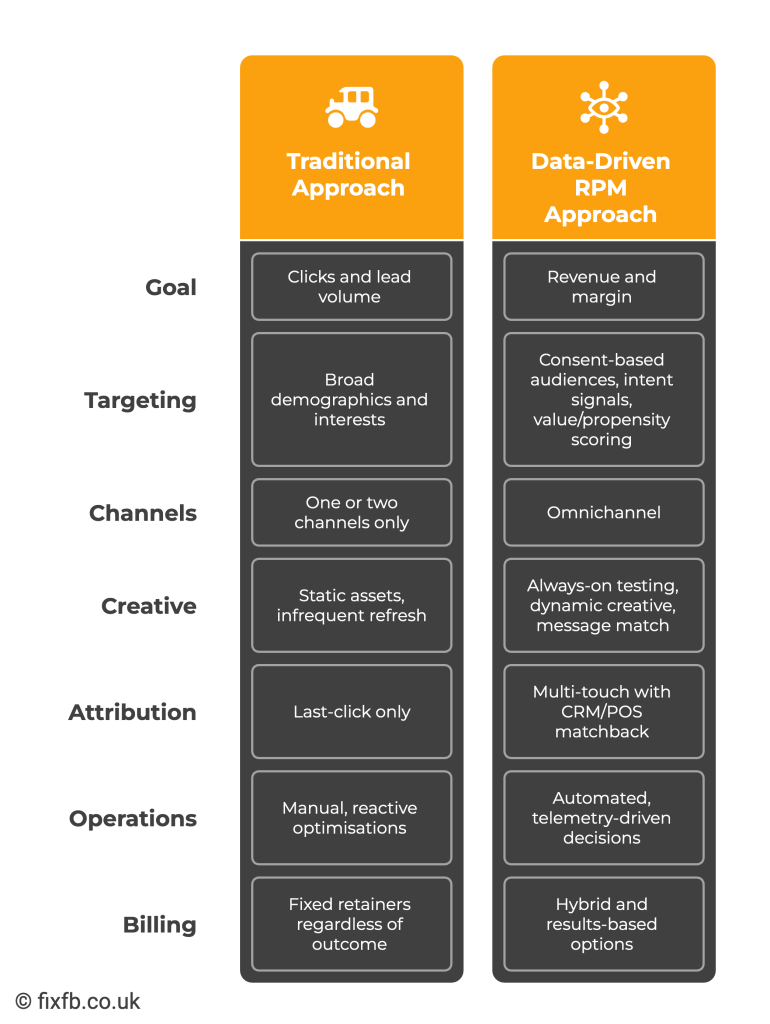
Bottom line: the traditional model optimises for activity; the data-driven RPM model optimises for profit and scales what actually pays back.
FAQs
What does a UK lead generation agency actually do?
We find and engage people already in the market, build compliant funnels that turn clicks into enquiries, and attribute revenue back to the exact channels, audiences and creatives that drove it. That means tighter targeting, faster follow-up, and budget flowing to what produces sales—not vanity metrics.
How quickly will I see results?
Simple, high-intent funnels (e.g., search + focused landing page) can generate qualified leads within days. More complex sales motions need data learning cycles to stabilise and hit target CPS/ROAS—typically 2–8 weeks, depending on volume, seasonality and how quickly sales outcomes feed back into optimisation.
Do you handle offline conversions?
Yes. We match CRM, POS and call-centre data back to campaigns so phone, in-store and field sales are included in the numbers. That gives you true ROAS and lets us reallocate budget to the keywords, audiences and messages that actually close.
Is your approach UK GDPR & PECR compliant?
Absolutely. Consent capture, data minimisation and lawful basis are engineered into forms, pixels and integrations. We log consent, respect preferences, and keep an audit-ready trail so your lead generation remains both effective and compliant.
Do you offer pay-per-lead?
Yes, where the unit economics and quality controls make sense. We’ll first model CPL against close rates, margins, and verification rules, agree on definitions for a qualified lead, and then run a pilot to ensure consistency before scaling.
Ready to Add Predictability to Your Pipeline?
Offernet’s award-winning lead-generation team operates from its Digital Command Centre in Cape Town, supporting clients across the UK—London, Manchester, Birmingham, Leeds, Glasgow, Edinburgh and Bristol—as well as nationwide, Europe and Africa.
Book your FREE Lead-Gen Consultation: offernet.net