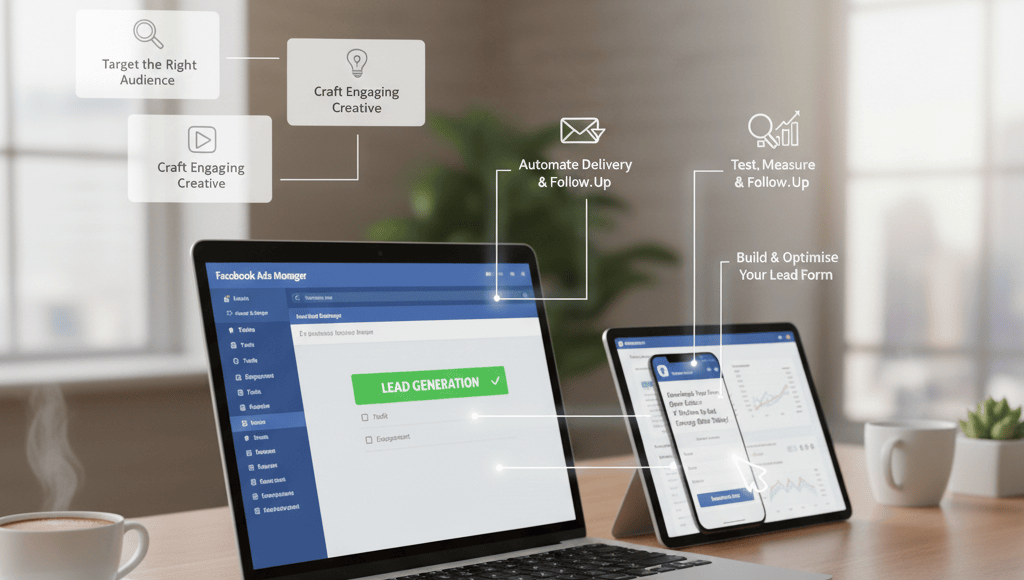
Lead Generation with Facebook Ads
If you want to grow your customer base online, lead generation with Facebook Ads is one of the most effective methods available today. With billions of monthly active users, Facebook gives businesses the opportunity to reach precisely targeted audiences and capture their contact details without requiring them to leave the platform.
In this guide, you’ll learn step-by-step how to set up lead generation campaigns on Facebook, optimise them for cost-effective results, and nurture those leads into paying customers.
Why Facebook Ads Work for Lead Generation
Facebook’s advertising platform allows you to:
Target with precision – use demographic, interest, and behavioural data to reach the right audience.
Reduce friction – capture lead details without users leaving Facebook.
Automate follow-up – connect with CRM tools and marketing automation platforms.
Measure performance – track impressions, clicks, form fills, and conversions in real-time.
These features make Facebook an indispensable tool for businesses looking to grow efficiently.
Choose the Right Campaign Objective
Before you design creative, write copy, or even think about your budget, you need to tell Facebook what your goal is. This is done by selecting a campaign objective inside Ads Manager. It might sound like a small decision, but it’s the foundation of your campaign’s success. If you get this step wrong, your ads may generate clicks or likes, but they won’t generate leads.
Why the Objective Matters
Facebook’s algorithm is designed to optimise delivery based on your chosen objective. If you select “Traffic,” Facebook will show your ad to people who are most likely to click links, not people who actually fill out forms. If you choose “Engagement,” you’ll attract likes and comments, but not necessarily leads. That’s why Lead Generation is the correct objective when your goal is to collect customer information directly from Facebook.
How to Set It Up in Ads Manager
Log into Ads Manager and click the green Create Campaign button.
From the list of objectives, choose Lead Generation.
Link your campaign to a verified Facebook Business Page. Only page admins can run lead ads, so make sure you have admin access before you begin.
If prompted, accept the Lead Ads Terms of Service. This is Facebook’s way of ensuring you understand the rules around collecting and handling personal data.
Pro Tips for Success
Never choose the wrong objective. Even if you’re tempted to start with “Traffic” for more clicks, remember clicks don’t pay the bills—leads do.
Use Business Manager. Running ads through Business Manager instead of a personal account gives you greater control, better security, and centralised access for your team.
Stay compliant. Facebook may prompt you to link to your privacy policy. Always provide one—it builds trust and helps keep you GDPR/POPIA compliant.
The Bottom Line
Getting the objective right is like giving your satnav the correct destination. Without it, you may end up wasting money on activity that doesn’t bring you closer to generating leads. Start every campaign with Lead Generation as your objective, and you set the algorithm up for success from day one.
Create a Compelling Offer
No one gives away their contact details without expecting something valuable in return. To make your Facebook Lead Ads work, you need to offer a clear, irresistible incentive that solves a problem or fulfils a need for your audience. This “value exchange” is what turns passive scrollers into motivated leads.
Why Offers Matter in Lead Generation
Think of your offer as the magnet that pulls people in. The stronger and more relevant it is, the more likely users are to stop scrolling, click your ad, and fill in their details. Without a strong offer, even the most beautiful ad creative won’t convert.
Types of Offers That Work
When brainstorming your lead magnet, keep your audience in mind. Here are proven options:
Downloadable Resources: eBooks, whitepapers, industry reports, or templates (e.g. “Download our 10-Step Guide to Mastering Social Media Ads”).
Discounts & Vouchers: A limited-time coupon or promo code for first-time buyers (e.g. “Get 15% off your first order when you sign up today”).
Free Consultations or Audits: Particularly powerful for service-based businesses (e.g. “Book your free 30-minute digital marketing audit”).
Exclusive Access: Early access to a new product, course, or event (e.g. “Join the waitlist for our exclusive product launch”).
Contests or Giveaways: A chance to win a prize in exchange for contact details (just make sure it aligns with your brand so you attract qualified leads).
Best Practices for Crafting Offers
Be Specific: Avoid vague promises like “free resources.” Instead, highlight the exact value: “Download our free 2024 Marketing Calendar Template.”
Solve a Real Problem: Focus on pain points your audience actually cares about. For example, a B2B firm could offer a cost-saving checklist, while an online retailer might provide style guides or discount vouchers.
Highlight Urgency or Exclusivity: Use phrases like “limited-time offer”, “exclusive access”, or “available for the first 100 sign-ups.” Urgency drives action.
Make It Easy to Consume: Short guides or actionable templates often convert better than lengthy reports no one has time to read.
Align Offer with Customer Journey: Someone at the awareness stage might prefer a free guide, while someone closer to purchase may respond better to a demo or discount.
Examples of Strong Ad Copy for Offers
“Struggling with high energy costs? Download our 10-Step Guide to Cut Your Bill by 30% Today.”
“Sign up now and get 20% off your first purchase – limited-time only!”
“Claim your free 30-minute consultation with our Facebook Ads experts.”
Pro Tips
A/B test different offers: You might find a free consultation outperforms a discount, or vice versa.
Localise your offer: For UK audiences, highlight VAT savings, free local shipping, or region-specific data insights.
Ensure GDPR/POPIA compliance: Always state how you’ll use data and link to your privacy policy in the form.
Bottom Line
Your offer is the currency of your Facebook Lead Ad. The more compelling, clear, and relevant it is, the more leads you’ll capture at a lower cost per lead (CPL). Without an attractive incentive, even the most optimised campaign won’t deliver results.
Build and Optimise Your Lead Form
Once you’ve grabbed attention with a compelling offer, the next critical step is to capture your audience’s details effectively. This is where Facebook Instant Forms come in. These forms are built directly into Facebook Ads, allowing users to submit their information without ever leaving the platform. The less friction in the process, the more leads you’ll collect.
Why Instant Forms Work
Auto-population: Facebook automatically fills in fields such as name, email, and phone number using the user’s profile data, reducing effort for the lead.
Mobile-first design: Most Facebook users browse on mobile, and Instant Forms are optimised for small screens.
Speed: No external redirects mean faster completion and less drop-off.
Steps to Build Your Form in Ads Manager
In Ads Manager, under your campaign, create a new Ad Set and select Lead Form.
Choose “Create Form.” You’ll see options for form type, questions, and completion screen.
Select between two types of forms:
More Volume: Optimised for higher completion rates with fewer fields.
Higher Intent: Adds a review screen before submission to filter more qualified leads.
Add required fields: Name, Email, Phone Number are the basics. Avoid overwhelming your audience.
Add a custom question only if absolutely necessary (e.g., “When are you planning to purchase?”).
Best Practices for Optimisation
Keep It Short: The fewer fields you include, the higher your completion rate. Three fields is the sweet spot.
Add a Privacy Disclaimer: Link to your Privacy Policy to comply with GDPR/POPIA regulations. This builds trust and keeps you compliant.
Use Conditional Questions: If you need to qualify leads, use logic-based questions (e.g., “Are you interested in commercial or residential services?”).
Optimise the Thank You Screen: Don’t just say “Thank you.” Add next steps like:
A link to download the promised resource.
A call-to-action button (“Visit Website” or “Book a Call”).
Contact details for immediate follow-up.
Pro Tips
Brand Your Form: Use your logo and consistent colours to make the form look professional.
Deliver Value Immediately: If your offer is an eBook or discount code, ensure the Thank You page provides instant access. Delays decrease trust.
Test Different Form Types: A “More Volume” form may bring quantity, while a “Higher Intent” form may deliver quality. Run A/B tests to find the best balance.
Compliance Considerations
Remember, you’re collecting personal data. Always:
Provide a clear Privacy Policy link.
Clearly state how you’ll use the data (e.g., “We’ll contact you with relevant offers and updates”).
Give users an easy way to unsubscribe later.
Bottom Line
A poorly designed lead form can undo all your hard work, even if your ad and offer are perfect. Keep it simple, professional, and frictionless. The goal is to make signing up as easy as a single tap — and to reassure users their data will be used responsibly.
Target the Right Audience
No matter how compelling your offer or how slick your ad creative, your campaign will fail if you show it to the wrong people. Audience targeting is the backbone of successful Facebook lead generation — it ensures your message reaches the people most likely to engage and convert.
Why Audience Targeting Matters
Facebook has over 2.9 billion monthly active users. Without precise targeting, your ads risk being lost in the noise or wasted on people who will never buy from you. Proper targeting not only improves lead quality but also helps reduce your Cost per Lead (CPL).
Core Targeting Options in Ads Manager
Custom Audiences
These are people who already know your business. You can build Custom Audiences from:Website visitors (using the Meta Pixel).
Customer lists (upload email or phone number databases).
App activity (if you have a mobile app).
Facebook engagement (e.g., people who interacted with your page or videos).
Why it works: Warm audiences are more likely to convert because they already recognise your brand.
Lookalike Audiences
Want more people like your best customers? Upload a list of your high-value customers and let Facebook find others with similar demographics, behaviours, and interests.Pro tip: Start with a 1% Lookalike for precision, then expand to 2-5% for scale once you’ve tested results.
Interest & Behavioural Targeting
Facebook allows you to target based on:Demographics: Age, gender, education, relationship status.
Interests: Hobbies, sports, entertainment, professional industries.
Behaviours: Online shoppers, business travellers, technology adopters.
This is ideal for reaching cold audiences who’ve never heard of you but match your buyer persona.
Geographic Targeting
Especially important for local businesses. You can target by:Country, city, or postcode.
Radius around a physical location (great for restaurants, gyms, or retail shops).
Avoid These Targeting Mistakes
Going Too Broad: If your audience is millions of people, your budget will spread too thin. Focus on segments most likely to convert.
Overlapping Audiences: Running multiple campaigns that target the same people increases ad fatigue and costs. Use the Audience Overlap Tool in Ads Manager to avoid duplication.
Ignoring Exclusions: Always exclude existing customers when running lead generation ads, unless you’re upselling. This saves budget and prevents irrelevant leads.
Best Practices for Smarter Targeting
Use Layering: Combine demographics, interests, and behaviours for a more precise audience (e.g., “Business owners” + “Located in London” + “Interested in digital marketing”).
Leverage Retargeting: Show ads to people who visited your website but didn’t convert. Retargeting campaigns often yield the highest ROI.
Update Audiences Regularly: Refresh customer lists and exclude unengaged users to keep campaigns efficient.
Segment by Funnel Stage:
Cold audience → awareness ads.
Warm audience → lead generation ads.
Hot audience → conversion-focused ads.
Action Steps
Install the Meta Pixel on your website and start building Custom Audiences.
Upload your existing customer database to create both Custom and Lookalike Audiences.
Define at least one cold audience using demographics, interests, and behaviours.
Exclude current customers if your goal is new lead generation.
Test small audience groups first (100,000–500,000 people) before scaling.
Audience targeting is not just about reaching people — it’s about reaching the right people. Mastering this step ensures your ads are shown to users who are most likely to engage with your offer, reducing wasted spend and increasing lead quality.
Craft Engaging Creative
Your targeting can be razor-sharp, but if your ads fail to catch the eye or stir curiosity, you’ll still struggle to generate leads. Creative is the first thing your audience sees, and it must stop the scroll, spark interest, and drive action.
Why Creative Matters
Think about your own behaviour: when scrolling through Facebook, do you pause for generic stock photos or dull headlines? Probably not. Strong creative builds trust, signals professionalism, and nudges people closer to clicking that lead form.
Elements of a High-Converting Facebook Ad
Visuals That Pop
Use high-resolution images or videos that are relevant to your offer.
Showcase the benefit visually (e.g., a mock-up of your free eBook, a smiling customer using your product, or a short explainer video).
Avoid text-heavy graphics — Facebook reduces reach for ads with too much text on images.
Consider brand consistency: your colours, fonts, and imagery style should align with your business identity.
Pro tip: Videos under 30 seconds outperform long-form ads for lead generation. Add captions since most users watch with the sound off.
Compelling Copywriting
Headline: Keep it punchy. State your value clearly (e.g., “Download Our Free Guide to Reduce Energy Bills by 20%”).
Primary Text: Lead with the problem your audience faces, then present your solution. End with urgency or exclusivity (“Limited offer”, “Today only”, “Be the first to know”).
Call-to-Action (CTA): Use direct, action-oriented phrases such as “Get Your Free Guide”, “Book Your Demo”, or “Claim My Discount”.
Ad Formats That Convert
Test multiple creative formats to find what resonates with your audience:Single Image: Best for simple offers and strong visuals.
Video: Perfect for demonstrating products or explaining complex offers.
Carousel: Showcase multiple benefits, products, or testimonials.
Instant Experience: An immersive, mobile-first format that feels like a mini landing page.
Consistency Across Funnel
The ad should reflect exactly what the user will get after clicking. If your ad promises a free consultation, make sure the lead form and thank-you page reinforce that promise. Mismatched creative and landing pages kill trust and conversions.
Best Practices for Creative That Converts
Clarity Over Cleverness: Clever ads are fun, but clarity is what converts. Make sure your audience instantly understands what you’re offering.
Leverage Social Proof: Add testimonials, star ratings, or quotes to show others already trust you.
Highlight Benefits, Not Features: Instead of “Download our 50-page report”, say “Learn how to cut costs and grow revenue in 10 steps”.
Mobile-First Design: Over 98% of Facebook users access via mobile, so ensure visuals are vertical-friendly and text is legible on small screens.
A/B Test Creative Variations: Test two versions of the same ad (different headline, image, or CTA) to see which performs better.
Action Steps
Choose a format that best suits your offer (start with image and video).
Create at least 2–3 variations of your ad creative for testing.
Use visuals that demonstrate the value of your offer.
Write copy that is simple, benefit-driven, and action-focused.
Add captions to videos and design creatives with mobile users in mind.
Your ad creative is the hook. It determines whether people stop scrolling long enough to read your message and take action. Get the creative wrong, and even the best targeting and budget won’t save your campaign. But get it right, and you’ll see lower CPLs, higher conversion rates, and stronger ROI.
Automate Lead Delivery and Follow-Up
Capturing a lead is just the beginning. What happens after someone fills in your form is just as important as getting them there in the first place. If leads sit in Facebook’s Ads Manager waiting for manual export, you’ll lose valuable time — and often the lead itself. Automation ensures every lead is instantly delivered to your systems and nurtured right away.
Why Speed Matters
Research shows that contacting a lead within the first 60 minutes drastically increases your chances of converting them. Wait a day, and that lead is often cold. Automation bridges that gap, ensuring no lead is left behind.
How to Automate Lead Delivery
Connect Facebook Lead Ads to Your CRM
Use integrations with CRMs such as HubSpot, Salesforce, Zoho, or Pipedrive.
This allows leads to flow directly into your sales pipeline with no manual intervention.
Sales teams can get real-time notifications when a new lead arrives.
Use Integration Tools
Platforms like Zapier, LeadsBridge, or Integromat (Make) connect Facebook Lead Ads to hundreds of apps.
Example: A new lead fills in your form → Zapier triggers an action → lead details are added to Mailchimp, your CRM, and Slack for team notifications.
Deliver Incentives Instantly
If you promised an eBook, discount code, or free consultation, automation ensures it’s delivered the moment someone completes your form.
Example: Integrate with your email platform so the lead receives a welcome email with the resource attached within seconds.
Segment Leads Automatically
Use form responses (like job title, budget range, or interest area) to categorise leads.
This allows you to separate high-intent leads from those that need more nurturing.
Set up different automated workflows depending on their segment.
How to Automate Follow-Up
Email Sequences
Send a welcome email immediately.
Follow up with 2–3 nurture emails over the next week providing value (case studies, testimonials, tips).
End with a stronger conversion CTA (e.g. “Book your free consultation today”).
SMS Automation
For industries like real estate or automotive, SMS automation works well because it feels personal and is read instantly.
Example: “Hi Sarah, thanks for your interest in our new property listings. Here’s the link to schedule a viewing.”
Retargeting Ads
Once a lead engages with you, add them to a Custom Audience.
Serve ads designed to move them further down the funnel (e.g., customer testimonials, free trials, or special offers).
Sales Notifications
Use automation to send instant notifications to sales reps on Slack, Microsoft Teams, or via email.
This ensures no hot lead gets missed.
Pro Tips for Automation
Always test the workflows: Submit a test lead form to check whether data flows correctly to your CRM and triggers emails/SMS.
Monitor drop-off points: Use analytics to see where leads stop engaging and adjust your nurture sequence accordingly.
Keep compliance in mind: Make sure your workflows respect data privacy regulations (GDPR, POPIA for South Africa, etc.).
Action Steps
Choose your CRM or automation platform.
Connect Facebook Lead Ads to your system.
Set up automated emails/SMS to deliver incentives.
Build segmentation rules for lead qualification.
Notify your sales team in real-time.
Automation ensures you don’t just capture leads, but actually convert them. The moment someone hits “Submit,” they should receive value, be added to your nurturing funnel, and appear in your sales team’s workflow. Done right, automation turns Facebook Ads into a 24/7 lead engine — no missed opportunities, no wasted ad spend.
Test, Measure, and Optimise
Launching a campaign is not the finish line — it’s the starting point. The real success of Facebook lead generation campaigns lies in continuous testing, measurement, and optimisation. Without these, even a well-structured campaign can plateau, waste budget, or attract poor-quality leads.
Why Testing and Measuring Matter
Facebook’s algorithm is powerful, but it’s not magic. It optimises based on the signals you give it. If you don’t track the right metrics or fail to make adjustments, you’ll struggle to improve results. Testing and measuring help you:
Reduce wasted ad spend.
Improve lead quality.
Identify what resonates with your audience.
Scale winning campaigns while eliminating underperformers.
What to Measure
CPL (Cost Per Lead)
Your baseline metric for efficiency.
But don’t obsess over CPL alone — a cheap lead that never converts is worthless.
Quality of Leads
Track how many leads turn into actual sales or consultations.
Use CRM data to evaluate conversion rates down the funnel.
Relevance and Quality Rankings
In Ads Manager, review Quality Ranking, Engagement Rate Ranking, and Conversion Rate Ranking.
Low scores often mean your ad creative or targeting needs a rethink.
Form Completion Rates
See how many people start filling out your form but don’t finish.
High drop-off = your form may be too long or confusing.
Response Time
Track how quickly your team follows up.
Leads that are left hanging for 24–48 hours are significantly less likely to convert.
Testing Ideas
Creative Testing (A/B)
Run two versions of an ad with different headlines, images, or CTAs.
Let them run long enough (at least a few days) to gather statistically valid data.
Offer Testing
Test whether your audience prefers a free guide, a discount code, or a free consultation.
You may be surprised which incentive converts best.
Audience Testing
Compare results between Lookalike Audiences, Custom Audiences, and interest-based targeting.
Use the Audience Overlap Tool to avoid cannibalising your own campaigns.
Placement Testing
Test ads across placements: Facebook Feed, Instagram Stories, Reels, Messenger.
Optimise budgets towards placements delivering the best CPL and lead quality.
Form Length Testing
Compare short vs. slightly longer forms.
Sometimes adding one qualifying question reduces lead volume but dramatically improves lead quality.
Optimisation Strategies
Pause and Scale
Pause underperforming ads to stop wasting spend.
Scale budgets on ads that consistently bring quality leads at acceptable costs.
Refine Targeting
Remove audiences that show high CPL and poor conversions.
Double down on the ones with strong ROI.
Creative Refresh
Ads fatigue quickly — swap out images, videos, and headlines every 2–4 weeks.
Keep your messaging fresh and aligned with current market trends.
Improve Landing Experience
If you’re driving to a landing page, test variations of the page itself.
Faster load times and clearer CTAs improve conversion rates.
Pro Tips
Set Clear Benchmarks: Decide upfront what success looks like (e.g. £10 per qualified lead).
Test One Variable at a Time: Don’t change multiple things at once; otherwise, you won’t know what caused the improvement.
Use Learning Phases Wisely: Allow campaigns to gather enough data (at least 50 conversions per week) before making big changes.
Think Quality Over Quantity: A smaller pool of high-intent leads beats hundreds of cheap but unqualified submissions.
Action Steps
Review your KPIs weekly (CPL, conversion rates, quality rankings).
Run at least one A/B test every week (creative, offer, or audience).
Shift budget to the top-performing ads and pause weak ones.
Refresh creative assets regularly to avoid ad fatigue.
Feed results back into your strategy for continuous improvement.
Testing, measuring, and optimising is the secret sauce behind consistent Facebook lead generation success. Think of your campaign as a living system: it must evolve with your audience, your offers, and Facebook’s algorithm. The brands that win aren’t the ones that launch perfect campaigns on day one — they’re the ones that test relentlessly, learn quickly, and optimise ruthlessly.
Ensure Compliance and Transparency
Running Facebook Ads for lead generation isn’t just about optimising campaigns and scaling results — it’s also about ensuring your business stays compliant with Facebook’s policies and legal frameworks like GDPR (for the UK and EU) or POPIA (for South Africa). Mishandling data or failing to disclose how you’ll use it can lead to your ads being disapproved, your Page restricted, or worse, regulatory fines.
Why Compliance Matters
User Trust: People are more willing to share their personal details if they know exactly how you’ll use them.
Platform Rules: Facebook requires advertisers to meet strict standards for transparency. Breaking these rules can result in penalties or account bans.
Legal Obligations: If you target users in regions governed by GDPR, POPIA, or other data protection laws, you’re legally required to handle leads responsibly.
How to Stay Compliant
Include a Privacy Policy Link
Every Facebook lead form requires a link to your company’s Privacy Policy.
Ensure your policy explains: what data you collect, why you collect it, how long you store it, and how users can opt out.
Don’t just copy and paste a template — tailor it to reflect your actual processes.
Use Clear Language in Lead Forms
Avoid vague phrases like “sign up for updates.” Instead, state exactly what users are signing up for (e.g. “Get weekly property alerts sent to your inbox”).
Make it clear if you plan to send follow-up marketing via email, SMS, or phone.
Honour Consent and Preferences
If users opt in only for one channel (e.g. email), don’t start calling or texting them without explicit permission.
Offer easy opt-out options in every communication.
Be Transparent with Incentives
If you’re offering a free guide, discount code, or webinar in exchange for contact details, deliver exactly what was promised.
Avoid bait-and-switch tactics — this not only breaches trust but may also violate Facebook’s Misleading Claims policy.
Handle Data Securely
Ensure that leads flow into a secure CRM system.
Restrict access to sensitive data only to authorised team members.
Regularly audit your processes to make sure you’re handling data properly.
Comply with Lead Generation with Facebook Ads Policies
Avoid restricted targeting practices (e.g. discriminatory targeting in housing, jobs, or credit ads).
Ensure ad copy and visuals are aligned with Facebook’s Advertising Standards.
Pro Tips for Transparent Lead Generation
Add a short disclaimer on your form’s “Thank You” screen explaining how you’ll follow up (e.g. “We’ll send your free guide to your email and follow up with occasional offers”).
Segment your email/SMS lists based on the consent given so you don’t overstep boundaries.
Regularly review Facebook’s Advertising Policies for updates, as rules evolve.
Compliance and transparency are not optional extras — they are the foundation of sustainable lead generation. When users feel safe sharing their details, and when you respect their preferences, your campaigns will not only perform better but also protect your business from penalties. By combining automation with ethical practices, you create a lead generation machine that is both effective and trustworthy.
Frequently Asked Questions (FAQ)
Q1. How much should I spend on Facebook lead generation ads?
It depends on your industry and goals. A safe starting point is £10–£20 per day to test performance. Scale up once you see results.
Q2. What industries benefit most from Lead Generation with Facebook Ads?
They work well for service businesses (real estate, finance, education, healthcare), e-commerce, B2B companies, and local businesses looking for appointments.
Q3. Are Facebook Lead Ads better than sending people to my website?
Lead Ads convert better because they reduce friction. However, if you need more information from users, sending them to a landing page may work better.
Q4. How quickly should I follow up with leads?
Ideally within one hour. The longer you wait, the lower your chance of conversion. Automating follow-ups is the best way to achieve this.
Q5. How do I know if my leads are high quality?
Track them through your sales funnel. Integrate Ads Manager with your CRM so you can monitor which leads actually purchase, not just fill in a form.
Q6. What happens if my ads aren’t delivering?
Check if your audience is too small, your budget is too low, or your ad creative is underperforming. Facebook’s diagnostic tools in Ads Manager will flag delivery issues.
Q7. Do I need Facebook Business Manager for Lead Ads?
Yes. Business Manager secures your assets and gives you better control over Pages, ad accounts, and lead access. Without it, you risk losing leads if your personal profile is compromised.
Lead generation with Facebook Ads is a powerful, cost-effective way to grow your business. By setting up a clear offer, designing simple forms, targeting the right people, and automating follow-ups, you can create a steady stream of high-quality leads.
If you’re new to Lead Generation with Facebook Ads or struggling with your campaigns, working with experts can save you time and money. At Offernet, we specialise in building and optimising lead generation systems for businesses in the UK, South Africa, and beyond.
👉 Book a free consultation at Offernet.net to unlock the full potential of Facebook advertising.