Meta AI ad targeting: GEM, Lattice and Andromeda decoded
In today’s competitive digital advertising environment, mastering Meta AI ad targeting is no longer optional; it’s essential. This article breaks down the often opaque workings of Meta’s latest AI-driven ad architecture, GEM, Lattice, and Andromeda from the perspective of a seasoned ad strategist, offering practical insight that many business users won’t find from Meta’s standard support.
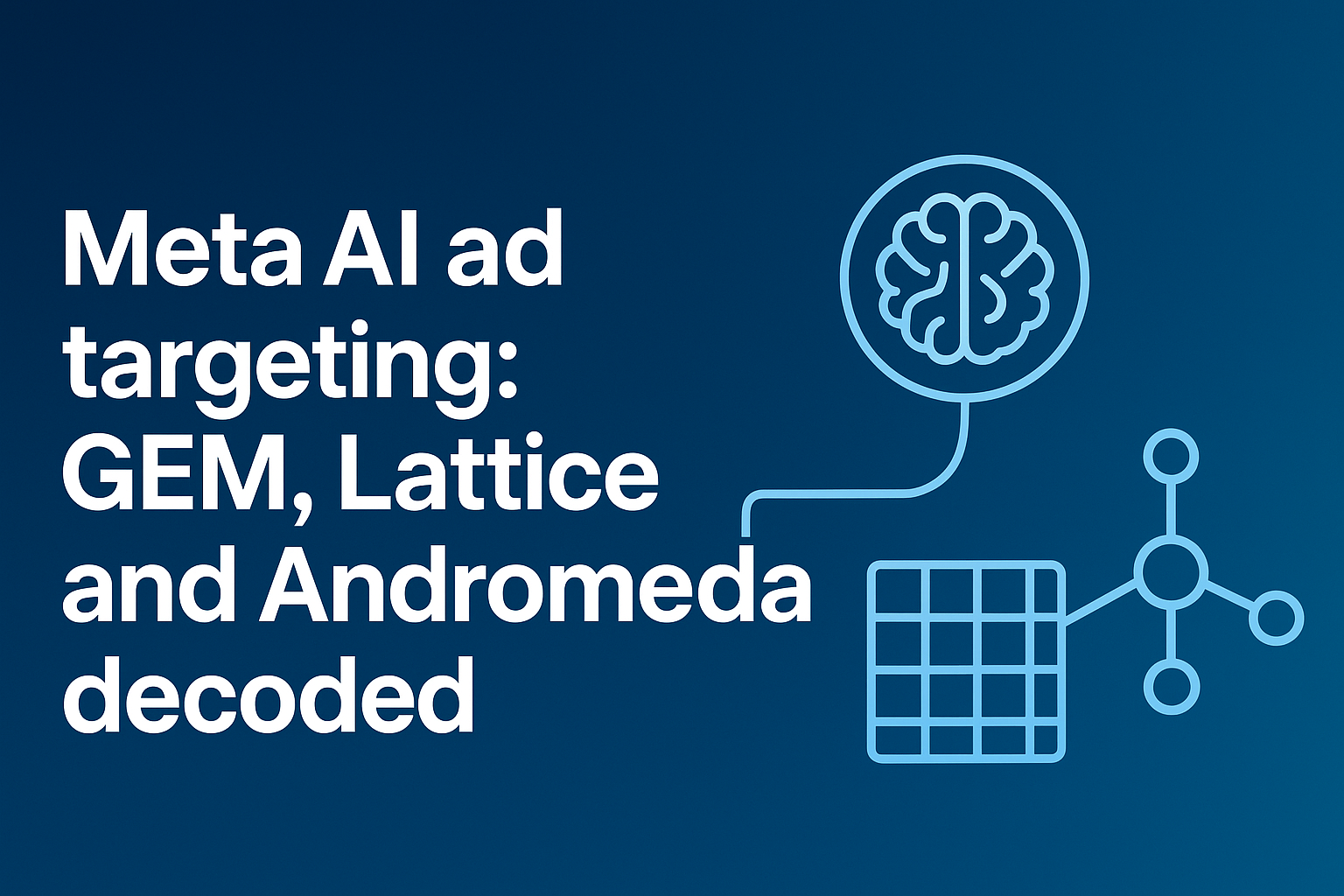
Meta’s new AI ad targeting model is built around three distinct yet interconnected systems, each playing a vital role in optimising which ads get seen, by whom, and when. The first is GEM, or the Generalised Entropy Model, which analyses enormous pools of user interaction data to detect latent patterns and underlying signals in how people respond to ads. GEM essentially learns what attributes, behaviours, or combinations tend to correlate with positive ad responses and then predicts which users might respond best to a given campaign. The second pillar is Lattice, which governs how different ad formats, placements and inventory types are distributed across users, ensuring that the system doesn’t overexpose one format or ignore another, and balancing reach with ad variation. Finally, Andromeda is Meta’s personalised retrieval engine: it refines the final selection of which ad version is most relevant for an individual user at that moment, drawing on signals about their preferences and context. Together, these three systems make Meta AI ad targeting far more dynamic and responsive than traditional targeting models.
One of the revelations Meta has shared is how the system is shifting from rigid, manually selected audiences to broader, algorithm-centred targeting, pushing more of the decision burden onto its AI models. GEM supplies the high-level insights, Lattice manages ad exposure across formats and placements to ensure diversity and avoid redundancies, and Andromeda handles precision matching at the user level. The result is a system that can react rapidly and contextually. For example, after someone books a holiday, they may stop seeing ads just for resorts and instead start being shown luggage, local experiences, or travel accessories. In effect, the AI learns the deeper user journey and adapts accordingly.
The technical sophistication behind Andromeda is particularly noteworthy. It acts at the so-called “retrieval” phase of Meta’s ad pipeline, selecting a smaller subset of candidate ads from a vast pool before more complex ranking stages apply further filtering. To manage this at scale, Andromeda is built using advanced neural network architectures, hierarchical indexing, hardware accelerators (including Nvidia’s Grace Hopper superchip and Meta’s own inference accelerators), and elastic model complexity, as needed per user segment. Meta reports that Andromeda improves retrieval recall and ad quality, providing measurable lifts in campaign outcomes. (Engineering at Meta)
From a practical standpoint, Meta AI ad targeting means advertisers must reconsider how they set up campaigns. The era of narrow, hyper-specific audience definitions is evolving. Instead, the system works best when given latitude broad targeting with strong creative signals, allowing the models to find subtle patterns across thousands or millions of impressions. That said, control is not lost: ad managers still define budgets, objective signals, and high-level constraints, but the AI models are doing more of the fine-tuning under the hood. Early reports suggest that campaigns leaning into Advantage+ (Meta’s automation suite) and employing creative variety tend to capture more of the gains from this architecture.
However, adopting Meta AI ad targeting isn’t without challenges. Some advertisers express concern that reducing manual targeting risks dilution or waste. A common question is: how broad is too broad? In practice, there appears to be a “sweet spot” in which audiences aren’t so narrow that the system can’t learn, nor so broad that signal noise overwhelms performance. Interestingly, some users report warnings in Ad Manager telling them to combine overlapping ad sets, because the system sees them as acting on essentially identical targeting. (Reddit) It seems Meta is nudging advertisers toward fewer, broader ad sets with more creative variation, trusting the AI to optimise delivery internally.
Another issue is the transition campaigns may pass through a “learning” phase as the models calibrate to new behaviours, creative sets or signals. During this period, performance may fluctuate. But once stable, campaigns operating under this AI-centric architecture may deliver better consistency, efficiency and scalable optimisations that manual targeting can’t match.
In summary, Meta AI ad targeting now relies on an integrated trio of systems GEM formulates the broad patterns, Lattice engineers exposure and format decisions, and Andromeda executes fine-grained personalised ad retrieval. For UK businesses using Meta’s ad tools, embracing this shift means designing campaigns with broader audiences, richer creative sets, and trust in the AI layers to surface optimal matches. It’s no longer purely about who we think should see ads the question is how well the AI can deduce who will respond. As Meta’s AI evolves, those who lean into this architecture early may outpace competitors still relying on legacy targeting approaches.
If you want help recalibrating your campaigns for optimal performance under Meta’s GEM, Lattice and Andromeda system, I can guide you step-by-step just ask.
Understanding Meta AI ad targeting is critical for modern advertisers. Meta’s architecture built around GEM, Lattice and Andromeda blends large-scale pattern learning, exposure management and personalised retrieval to drive smarter ad delivery. While it requires a shift in mindset away from tight manual targeting, it offers significant upside in scalability and efficiency. As the AI continues to improve, those who align with its strengths will likely achieve a competitive edge in performance.