Meta AI Chat Ad Data Usage: What the Global Policy Shift Means for UK Business Strategy
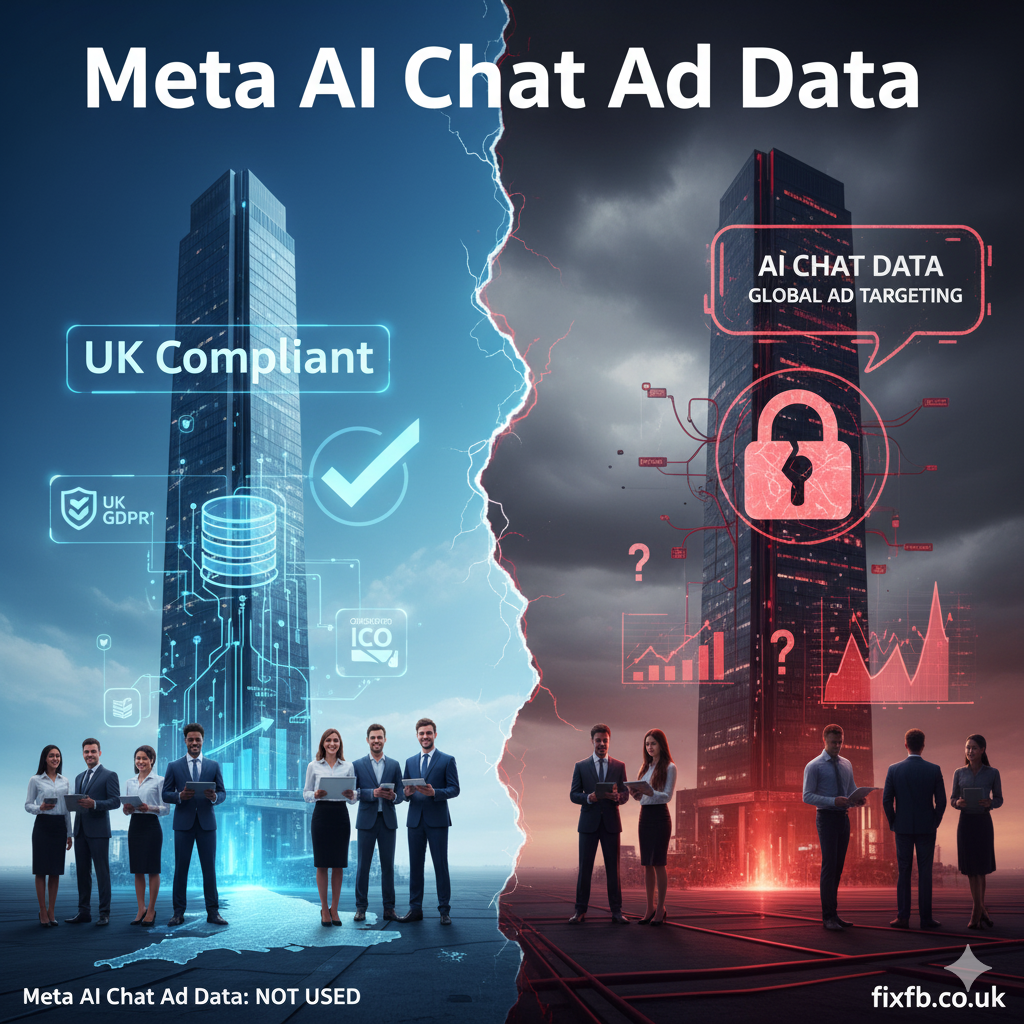
The digital advertising ecosystem is rarely static, and Meta Platforms, in its relentless pursuit of data signals and competitive parity with emerging rivals, has unveiled a significant new frontier: the leveraging of consumer interactions with its artificial intelligence assistant to inform personalised advertising and content recommendations. This strategic manoeuvre, which makes conversations with Meta AI part of the signals the company analyses for ad targeting, has profound global implications for privacy and campaign effectiveness. For the UK market, however, the narrative immediately shifts from alarm to a strategic advantage, because the deployment of Meta AI chat ad data for targeting purposes will not be applied to users in the United Kingdom. This crucial exemption, necessitated by the rigorous demands of UK data protection laws, including the UK GDPR, creates a definitive bifurcation in the global advertising landscape. As specialists, our role is to guide British enterprises through this dichotomy, understanding the global mechanism while advising on how the UK’s ring-fenced regulatory environment necessitates a superior, more compliant advertising strategy to maintain competitiveness and trust.
Globally, outside of specific jurisdictions, the integration of Meta AI chat ad data is positioned as a direct attempt by the tech giant to counteract the headwinds faced from rising privacy restrictions and increased competition. The sheer volume of data generated by an AI assistant—covering everything from travel plans and purchase intentions to specific questions about products and services offers Meta a goldmine of inferred intent, allowing its algorithms to serve highly contextual ads. This change is scheduled to take effect in regions where data privacy rules are less restrictive, effectively using the vast pool of conversational data to fine-tune the delivery of both organic posts and paid advertisements. For businesses operating in these unprotected territories, this means a potential, albeit unpredictable, boost in ad relevance, but at the cost of significantly greater user privacy intrusion and higher regulatory risk. This global shift underlines Meta’s commitment to AI-driven personalisation, demonstrating that even as traditional cookie data diminishes, the pursuit of granular user signals via direct platform interaction remains paramount. You can find Meta’s official statement and more details on the functionality of the AI assistant on their Meta AI Information Hub. However, for a UK business, this mechanism is largely theoretical when targeting the domestic audience, demanding a focus on proven, permission-based data streams rather than relying on automated AI inferences.
The explicit exclusion of the UK market from the use of Meta AI chat ad data is not a feature; it is a regulatory protection, and one that smart UK businesses should immediately leverage as a competitive advantage. Data privacy regulations in the UK are among the world’s most stringent, directly preventing Meta from deploying this level of conversational data analysis for ad personalisation without explicit, informed user consent. This exemption means that UK advertising targeting remains anchored in established signals: first-party data (via the Conversions API), on-platform behaviour (likes, shares, clicks), and traditional demographic data. For the UK marketer, this removes the unpredictable volatility inherent in an AI-driven, inferred-data targeting system. Rather than chasing the ephemeral promise of AI chat insights, UK businesses are compelled to invest in robust, compliant strategies, such as meticulously managing their first-party data and ensuring all practices adhere strictly to local legislation. Businesses are advised to consult the Information Commissioner’s Office (ICO) Guidance for a definitive understanding of their obligations regarding data processing and consent under the UK GDPR. This disciplined, permission-based approach inherently fosters greater user trust, distinguishing UK firms from international competitors who may be seen as capitalising on less transparent data collection methods.
Furthermore, the non-application of Meta AI chat ad data for domestic UK targeting has profound implications for ad optimisation strategy. Since UK campaigns cannot rely on the ‘secret sauce’ of AI conversation analysis, the focus must shift entirely back to the creative and offer. If the algorithm cannot use deeply personal conversational intent to find a user, the advertiser must use compelling, highly relevant creative and copy to self-qualify the audience. This means relentless A/B testing of visual assets, refining the ad copy to perfectly align with specific customer pain points, and ensuring landing pages are compliant and seamlessly connected to the campaign objective. Any UK firm marketing internationally, however, faces a dual challenge: maintaining their privacy-compliant UK domestic campaigns while simultaneously adapting strategy when targeting users in jurisdictions where the AI chat data is active. This international targeting must account for the likelihood that users in those regions are seeing highly specific, AI-tailored ads, requiring UK firms to adopt competitive and hyper-personalised creatives to cut through the noise, even if the underlying data signal mechanism is opaque to them. The critical technical countermeasure against this global change, even for UK businesses, is the full implementation of the Meta Conversions API, ensuring high-quality, explicitly consented conversion data is fed directly to Meta’s ad system, bypassing browser restrictions and providing the algorithm with the most reliable signals possible.
The broader ethical and consumer trust implications of this global shift cannot be ignored, even in the UK’s protected environment. The public narrative surrounding the use of Meta AI chat ad data casts a shadow over the entire platform, prompting greater consumer scrutiny over all data use. For UK businesses, this translates into a powerful opportunity to position themselves as ethical data stewards. Simply being compliant with UK law is the baseline; actively communicating a commitment to privacy, being transparent about data handling, and explicitly confirming that user chat data is not used for ad targeting for UK consumers can become a significant competitive differentiator. This proactive communication builds a layer of trust that intangible AI signals cannot replicate. In a market where customer loyalty is increasingly tied to corporate ethics, turning the UK’s regulatory obligations into a marketing advantage is a move that savvy enterprises must make to fortify their brand reputation against global platform controversy. This emphasis on first-party data quality and compliant operations is the only sustainable pathway to long-term success.
In conclusion, while the announcement regarding the leveraging of Meta AI chat ad data is a seismic event in the global digital advertising landscape, its direct impact on UK businesses is defined by a crucial exemption. This exemption should not be viewed as a limitation, but rather as an imperative and a privilege. It forces UK firms to ignore the distracting pursuit of AI-driven inferred intent and instead double down on superior, compliant, first-party data strategies. The future of high-performing advertising for UK enterprises lies in mastering the Conversions API, meticulously segmenting Custom Audiences based on explicit consent, and employing creative that is so relevant and compelling that it outperforms even the most sophisticated AI targeting. By embracing the UK’s robust data protection framework as a strategic foundation, businesses can secure a competitive edge, ensuring their growth is built not on questionable data practices, but on transparency, trust, and exceptional execution. For a deeper understanding of how to collect compliant, high-quality data to fuel your UK campaigns, consult our expert guide on Mastering Facebook Lead Generation for UK Success.