Meta Wins Antitrust Case Against the FTC: What the Ruling Means for UK Businesses Using Meta Platforms
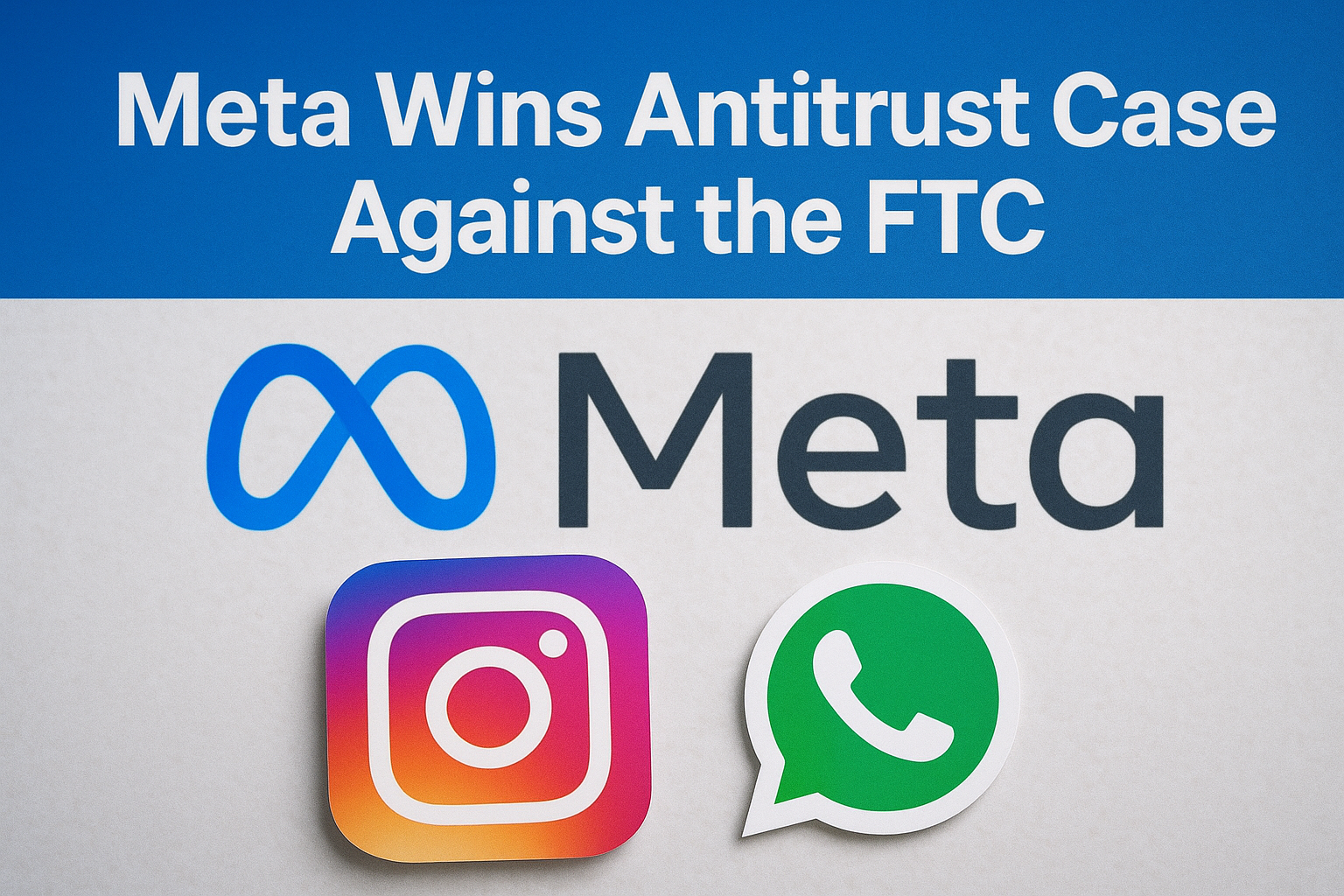
Meta wins antitrust case, a landmark decision that sees the social-media giant emerge victorious in its prolonged legal battle with the U.S. Federal Trade Commission. In a ruling that could have reshaped one of the world’s most powerful tech conglomerates, a federal judge has concluded that Meta did not illegally stifle competition through its acquisitions of Instagram and WhatsApp, allowing the company to retain both businesses and keep its social media empire intact.
The case originally began in 2020, when the FTC launched its suit alleging that Meta maintained a social networking monopoly through what it described as a “buy-or-bury” strategy, accusing Meta of acquiring Instagram and WhatsApp to neutralise potential rivals. After years of litigation, a judge has now ruled decisively in Meta’s favour, underlining that the regulatory body failed to prove Meta exerted illegal dominance. (Social Media Today)
Crucially, the judge recognised that the FTC’s conception of Meta’s competitive market was too narrow, focusing only on a “personal social network” sandbox that included just Facebook, Instagram, Snapchat, and MeWe. In reality, Meta successfully argued, competition also comes from video-centric platforms such as TikTok and YouTube, and that those are legitimate substitutes for its services. The court agreed, noting how consumer behaviour has shifted dramatically, with users allocating significant time to apps once considered separate from “social networking” in the FTC’s narrow definition.
Meta, for its part, framed its acquisition strategy as a valid business practice: rather than always building features in-house, buying companies like Instagram and WhatsApp can be a rational and efficient way to evolve. The judge accepted that argument. He also ruled that the FTC had not sufficiently demonstrated that Meta’s past acquisitions created an ongoing monopoly or that it continues to dominate the market in a way that warrants breaking up its business.
This ruling is being framed as a major win for Meta, but it is also emblematic of how regulators sometimes struggle to apply antitrust law to fast-evolving tech companies. The legal battle highlights the challenges in defining what constitutes the “relevant market”. As social platforms converge and overlap in functionality, regulators may need to reconsider how they assess whether a company has monopoly power. Boasberg, the judge, even noted that the traditional divide between social media and short-video platforms is outdated.
For Meta, the verdict removes a huge cloud of legal risk. The company can now move forward without the immediate threat of being forced to divest its two most crucial apps, Instagram and WhatsApp. Observers will also be watching whether Meta revives or accelerates plans to integrate its messaging services more tightly, something some had speculated it had slowed down during the trial.
From the perspective of businesses that rely on Meta’s platforms, this outcome is significant. For advertisers, marketers, and small businesses, the ruling provides reassurance: Meta’s suite of products remains under one umbrella, reducing the risk of disruption or major structural change. It means continued access to integrated ads, messaging, and engagement tools across Instagram, WhatsApp, and Facebook.
Ultimately, Meta wins antitrust case not just in form, but rather in substance: the court has accepted that the company faces serious competition, that buying firms is a legitimate strategic choice, and that its scale today does not equate to an illegal monopoly. This decision will likely shape future regulatory and competition battles, particularly as digital platforms evolve and overlap more than ever.