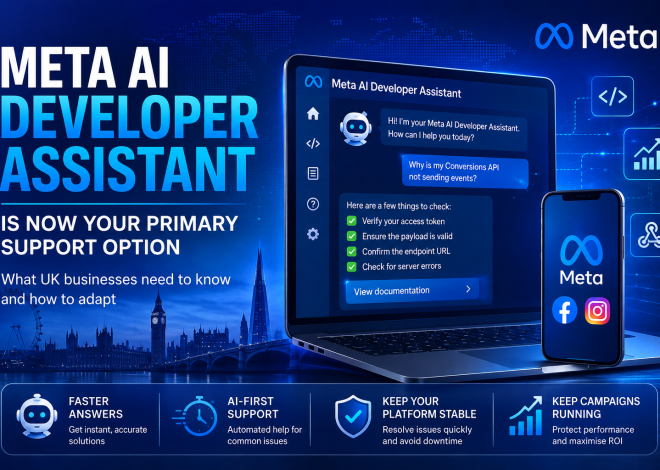
Meta Ad Serving Updates and What They Mean for Advertisers
Understanding Meta Ad Serving Updates and How They Impact Campaign Performance, Delivery Optimisation, and Ad Efficiency for Businesses:
Meta ad serving updates have become a significant focus for businesses relying on Facebook and Instagram advertising, as Meta continues to refine how its advertising system distributes budgets, optimises placements, and improves overall campaign performance. For many advertisers, understanding Meta ad serving updates is no longer optional, but essential for maintaining visibility, controlling costs, and achieving consistent return on ad spend in an increasingly competitive digital environment. These updates reflect Meta’s ongoing efforts to enhance automation, reduce inefficiencies, and provide advertisers with more reliable performance outcomes, particularly through its evolving Advantage+ and machine learning-driven systems.
From an expert standpoint, Meta ad serving updates represent a shift away from manual control and towards intelligent automation. Historically, advertisers had far more granular control over audience targeting, placements, and bidding strategies. However, Meta has steadily reduced reliance on manual optimisation in favour of algorithmic decision-making. This means the platform now determines when, where, and to whom ads are shown based on predictive performance signals gathered from user behaviour, engagement history, and conversion likelihood. As a result, businesses must adapt their strategies to align with how Meta’s delivery systems interpret campaign objectives.
One of the most important aspects of Meta ad serving updates is the improvement in ad distribution efficiency. Meta has been investing heavily in ensuring that ads are not just shown to relevant audiences, but shown at the optimal time and in the most effective format. This includes refinements in how ads compete in auctions, how budgets are allocated across placements such as Facebook Feed, Instagram Stories, Reels, and Audience Network, and how learning models prioritise high-value conversions. For businesses advertising on Meta platforms, this means that campaign performance is increasingly influenced by how well the system can interpret conversion signals rather than how precisely audiences are manually defined.
Another key development within Meta ad serving updates is the enhanced use of machine learning in optimisation. Meta’s algorithms now analyse vast datasets in real time, adjusting ad delivery dynamically to maximise performance outcomes. This includes identifying patterns in user behaviour that indicate purchase intent, engagement likelihood, or long-term value. For advertisers, this can lead to improved results when campaigns are properly structured, but it can also create confusion when performance fluctuates during the learning phase. Many businesses mistakenly interpret early volatility as underperformance, when in reality it is part of the system refining its delivery logic.
At fixfb.co.uk, this is a common issue raised by business users who feel unsupported by Meta’s own help channels. Meta ad serving updates often introduce changes that are not clearly explained in accessible terms, leaving advertisers uncertain about why their reach has dropped or why costs have increased. In reality, these changes are often linked to shifts in auction dynamics or improvements in predictive modelling. Understanding this distinction is critical for maintaining campaign stability and avoiding unnecessary adjustments that can disrupt learning phases and negatively impact performance.
Meta ad serving updates also place greater emphasis on conversion tracking accuracy. With privacy regulations tightening globally and the gradual reduction of third-party tracking, Meta has invested heavily in tools such as the Meta Pixel, Conversion API, and aggregated event measurement. These tools allow advertisers to provide more reliable data back to Meta’s systems, ensuring that ad delivery is optimised based on more complete and accurate signals. Businesses that fail to implement these tracking solutions correctly often experience degraded performance, as the system lacks the data required to effectively optimise delivery.
In addition, Meta ad serving updates have improved cross-platform integration between Facebook and Instagram. This means campaigns are no longer optimised in isolation per platform but are instead treated as part of a unified ecosystem. Advertisers benefit from broader reach and more efficient budget allocation, but this also reduces the ability to isolate performance by platform without deeper reporting analysis. For many business users, this shift requires a more strategic approach to reporting and interpretation of results, rather than relying on surface-level metrics alone.
Despite these improvements, challenges remain. One of the most significant concerns with Meta ad serving updates is reduced transparency. While automation improves efficiency, it also limits visibility into exactly why certain ads are shown or why specific audience segments are prioritised. This lack of clarity can be frustrating for advertisers who are accustomed to manual optimisation. It also places greater importance on creative quality, as Meta increasingly relies on engagement signals such as click-through rates, video watch time, and interaction levels to determine ad relevance.
Businesses that understand how Meta ad serving updates function are better positioned to adapt their advertising strategies effectively. Rather than constantly adjusting targeting or budgets, successful advertisers focus on providing high-quality creative assets, ensuring proper tracking implementation, and allowing sufficient time for machine learning systems to optimise delivery. Frequent manual changes can reset learning phases, reducing efficiency and increasing cost per result.
In practice, the impact of Meta ad serving updates is most visible in campaign performance consistency. Well-structured campaigns that align with Meta’s optimisation models tend to see improved stability over time, while poorly configured campaigns may experience unpredictable results. This is why expert guidance is increasingly important, particularly for businesses that rely heavily on Facebook advertising as a core revenue channel.
Ultimately, Meta ad serving updates reflect the broader direction of digital advertising towards automation, predictive modelling, and AI-driven decision-making. While this creates new challenges in terms of control and transparency, it also offers significant opportunities for businesses that are willing to adapt. By understanding how Meta ad serving updates influence delivery, optimisation, and performance, advertisers can make more informed decisions and improve long-term outcomes.
For businesses struggling to interpret these changes, platforms like fixfb.co.uk provide valuable insights and support that are often missing from Meta’s own help documentation. As Meta continues to evolve its advertising systems, staying informed and adapting strategies accordingly will remain essential for maintaining competitive advantage in the digital advertising landscape.