Teen Social Media Access Australia Ban Loopholes Exposed
Australia’s ongoing struggle with regulating underage participation on digital platforms has brought renewed attention to the issue of teen social media access, particularly as reports confirm that a significant proportion of teenagers continue to use social media despite formal restrictions and platform policies designed to prevent it. What appears on paper to be a straightforward regulatory framework is, in practice, far more complex, with enforcement gaps, technological limitations, and user behaviour all combining to undermine intended safeguards. For policymakers, platform operators, and businesses relying on social media ecosystems, the implications are increasingly difficult to ignore.
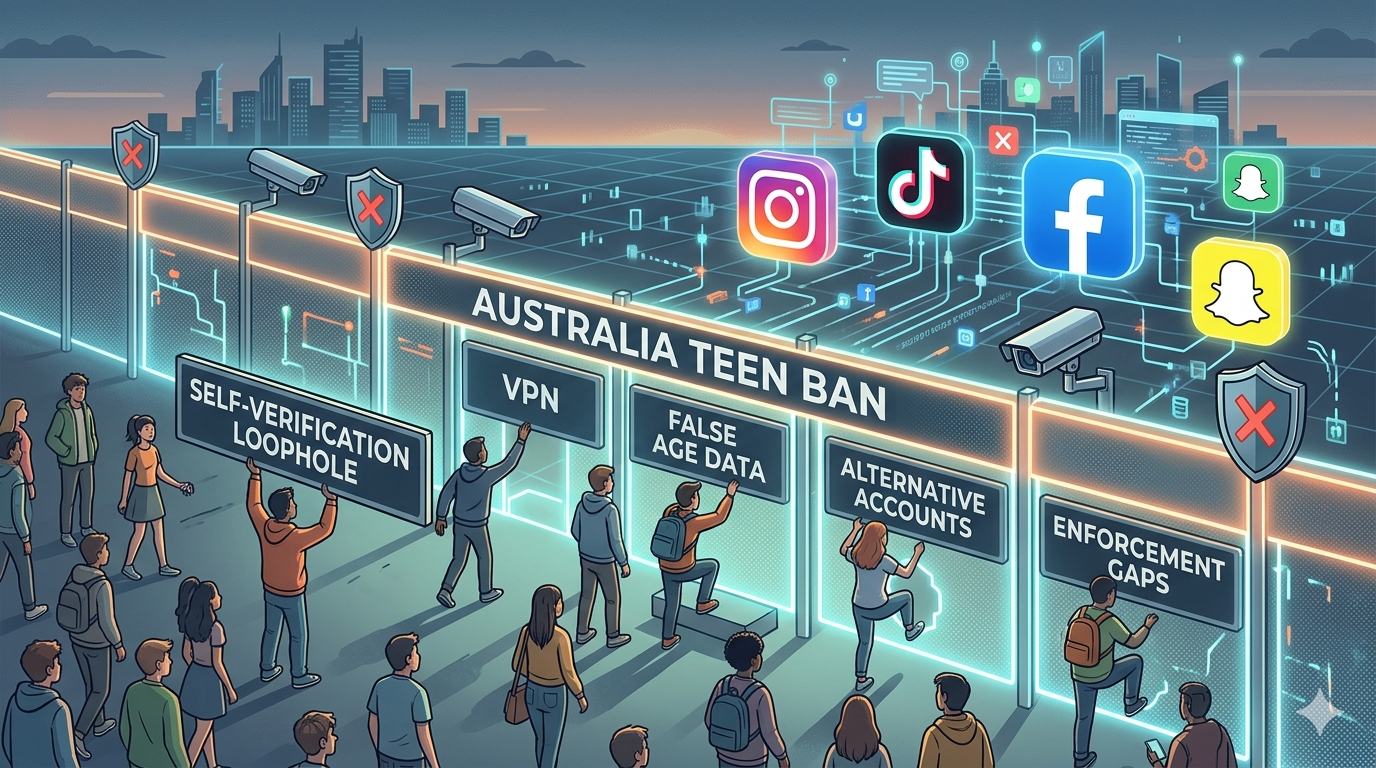
At the centre of the issue is the persistent reality of teen social media access despite age-based restrictions. Although platforms like Facebook, Instagram, TikTok, and others officially enforce minimum age requirements, the mechanisms used to verify age remain largely self-declared and therefore easy to bypass. Many teenagers simply input false birth dates during account creation, a practice that has become so commonplace it is often viewed as a normal part of online onboarding rather than a breach of terms. This creates a structural weakness in the enforcement system, where rules exist but verification is inconsistent at best.
The Australian case highlights a broader global challenge rather than an isolated incident. Even with increased public scrutiny and political pressure, teen social media access continues to flourish due to the fundamental architecture of most social platforms, which prioritise user growth and engagement over strict identity verification. While some platforms have introduced AI-driven moderation tools and behavioural analysis systems to detect underage users, these methods are not yet precise enough to reliably distinguish between older teenagers and young adults without risking significant false positives.
Another contributing factor is the ease with which digital identities can be manipulated. Teenagers often use borrowed devices, altered personal information, or alternative accounts to maintain access even when one account is removed. This creates a cycle where enforcement actions lead to temporary disruption rather than long-term prevention. As a result, teen social media access becomes less about formal permission and more about digital persistence, where determined users find multiple pathways to remain active online.
From a regulatory standpoint, Australia’s efforts reflect a growing international concern about youth exposure to algorithm-driven content environments. Governments are increasingly aware that teen social media access is not merely a question of account eligibility but one of broader digital wellbeing, including exposure to targeted advertising, addictive content loops, and potentially harmful online interactions. However, enforcing meaningful restrictions requires collaboration between legislators and technology companies, and this relationship has often been strained by differing priorities and interpretations of responsibility.
For businesses and digital marketers, the persistence of teen social media access presents both ethical and strategic considerations. On one hand, teenagers represent a highly engaged audience segment that influences trends, brand perception, and viral content cycles. On the other hand, advertising to users who may be underage raises compliance concerns, particularly in regions where data protection laws and youth marketing regulations are tightening. The lack of reliable age verification complicates targeting strategies and increases the risk of unintentional policy violations.
Education systems and parents also play a significant role in shaping outcomes, yet their influence is often limited by the pervasive nature of social platforms. Even where parental controls are available, teenagers frequently demonstrate a high level of digital literacy that allows them to circumvent restrictions. This reinforces the idea that teen social media access is not solely a technological issue but a social one, embedded in broader cultural expectations around connectivity, communication, and online identity formation.
The Australian findings also raise important questions about the effectiveness of current platform governance models. If teen social media access continues at scale despite formal bans and guidelines, then the underlying enforcement architecture may require fundamental redesign rather than incremental adjustment. This could involve stronger identity verification systems, integration with government-issued digital IDs, or more aggressive algorithmic detection tools. However, each of these solutions introduces its own challenges around privacy, data security, and user autonomy.
There is also a reputational dimension for platforms themselves. Public awareness of ongoing teen social media access despite stated restrictions can undermine trust in platform governance and regulatory compliance. For companies operating in the social media space, maintaining credibility with regulators, advertisers, and users depends on demonstrating that safety policies are not only written but effectively enforced. The gap between policy and practice therefore becomes a critical business risk factor.
Looking beyond Australia, the situation serves as a cautionary indicator for other markets considering stricter age-based digital regulations, including the United Kingdom and parts of Europe. If enforcement mechanisms remain dependent on self-reported data, then teen social media access will likely continue to outpace regulatory intent. This raises the possibility that future policy discussions will shift away from simple age thresholds towards more sophisticated, behaviour-based or consent-driven models of access control.
Ultimately, the persistence of teen social media access despite bans underscores a fundamental tension in the digital economy: the desire to protect younger users while maintaining open, scalable platforms that encourage participation. Until this tension is resolved through more robust verification systems or redesigned platform architectures, gaps between regulation and reality are likely to persist. For businesses, policymakers, and platform operators alike, the challenge is no longer just about setting rules, but about ensuring those rules can meaningfully function in an environment designed for frictionless access and rapid engagement.