AI Data Centre Tulsa: Meta’s Billion-Dollar AI Infrastructure Expansion Explained
AI Data Centre Tulsa and the Future of AI Infrastructure Expansion:
Meta’s announcement of a major AI data centre in Tulsa, Oklahoma, has become a significant reference point in understanding how large-scale infrastructure is evolving to support artificial intelligence workloads. The AI data centre Tulsa project represents a substantial expansion of Meta’s global computing capacity and signals how deeply AI is now embedded into the company’s long-term strategy. According to Meta’s own announcement, this facility will be its first in the state, part of a wider network of global data centres designed specifically to handle intensive AI processing demands.
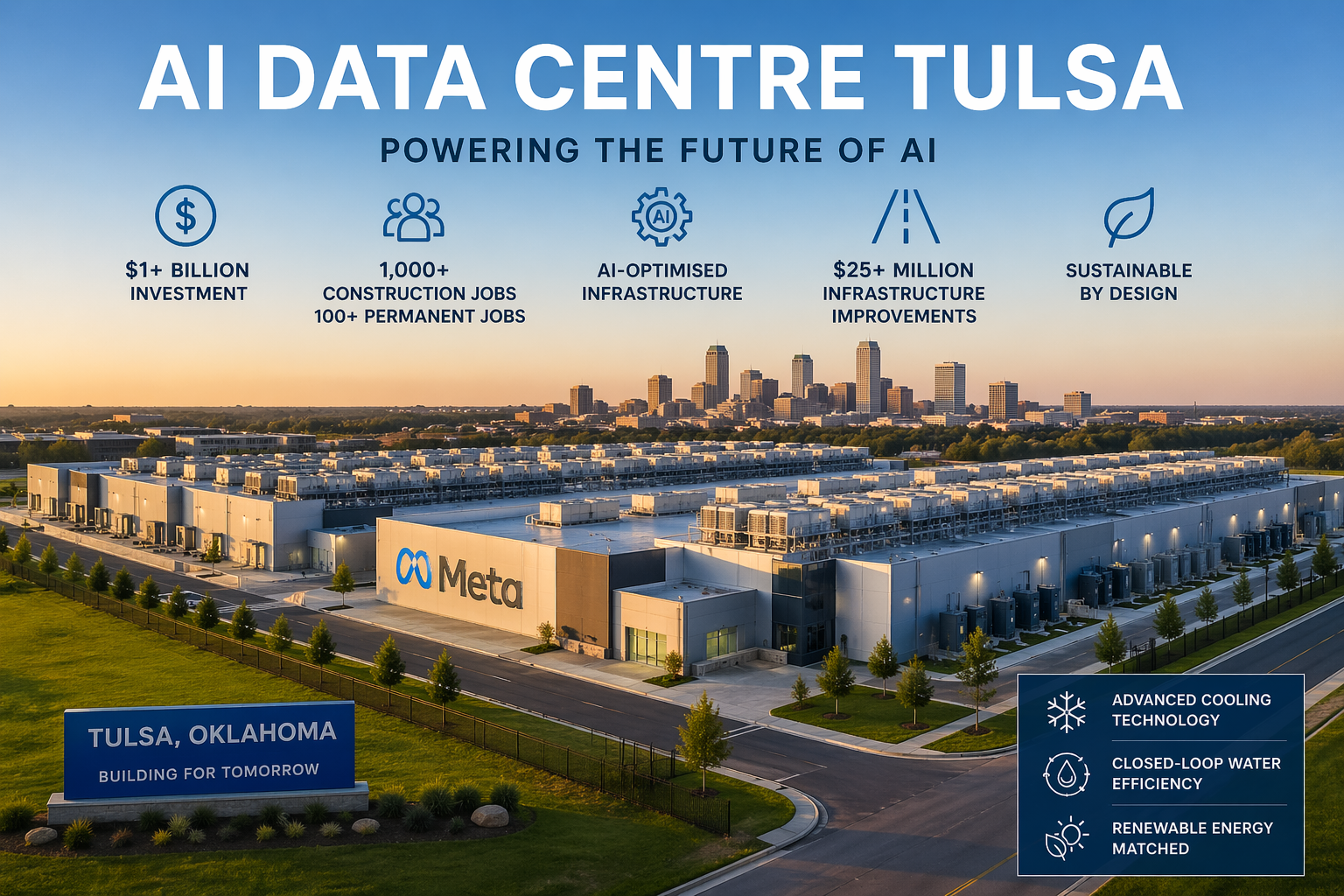
The project is not just a technical upgrade but a multi-billion-dollar investment into regional infrastructure. Meta has confirmed that the development represents more than $1 billion in investment, positioning it as one of the largest technology infrastructure projects in the region’s history. From a business and SEO perspective, this makes AI data centre Tulsa a highly competitive keyword cluster, particularly as companies like Meta, Google, and Microsoft continue to scale their AI infrastructure footprint across the United States.
At its core, the AI data centre Tulsa facility is designed to optimise AI workloads that power platforms such as Facebook, Instagram, and WhatsApp, while also supporting future AI developments across Meta’s ecosystem. The company has made it clear that this site will be part of its “AI-optimised” infrastructure strategy, meaning it is engineered specifically for high-performance computing rather than traditional data storage alone. This distinction is important because it highlights a shift in how modern data centres are being designed: not simply as storage hubs, but as computational engines for artificial intelligence.
From an economic perspective, the AI data centre Tulsa development is expected to generate substantial local employment opportunities during both construction and operational phases. At peak construction, more than 1,000 workers are expected to be on-site, with approximately 100 permanent roles once operational. While these figures may appear modest in long-term employment terms, the wider economic impact is amplified through supply chains, infrastructure upgrades, and local service demand. Meta has also committed over $25 million towards local infrastructure improvements, including road and water systems, which further embeds the AI data centre Tulsa project into the regional economy.
One of the most discussed aspects of this is its sustainability and energy strategy. Meta has emphasised that the facility will use advanced cooling systems and aims to operate with high water efficiency through a closed-loop system that recirculates water to minimise consumption. In addition, the company has stated that it will match electricity usage with renewable energy investments, reinforcing its broader environmental commitments. However, as with most large-scale AI infrastructure projects, questions remain around long-term energy demand and grid pressure, particularly as AI workloads continue to grow exponentially.
From a digital infrastructure standpoint, the AI data centre Tulsa project also reflects a wider industry trend. Major tech companies are now competing not just on software innovation but on physical infrastructure capacity. Data centres have become strategic assets in the AI race, enabling faster processing, lower latency and greater control over proprietary models. In this context, the AI data centre Tulsa is not an isolated development but part of a global expansion wave driven by the need for scalable AI computing power.
For businesses and digital marketers monitoring SEO trends, the keyword represents a broader opportunity. Search interest is closely tied to themes such as AI infrastructure, Meta investments, data centre construction, and US technology expansion. Content that addresses these topics with depth and clarity is likely to perform well in search rankings, particularly as competition increases for authoritative coverage of AI infrastructure news.
Ultimately, the highlights how artificial intelligence is reshaping not only digital platforms but also physical economies and infrastructure planning. It demonstrates the scale at which companies like Meta are investing to future-proof their systems, while also raising important discussions around sustainability, energy consumption, and regional economic impact.
As AI continues to evolve, developments like the AI data centre in Tulsa will become increasingly central to how global digital ecosystems function. For businesses, developers, and policymakers alike, it serves as a clear indicator that the future of technology is being built not just in code, but in concrete, steel and energy grids across regions like Tulsa and beyond.