Meta Orbital Solar Energy and the Future of Global Tech Infrastructure
Meta Orbital Solar Energy and the Future of Space-based Renewable Infrastructure
Meta’s growing interest in Meta orbital solar energy represents one of the most ambitious shifts in corporate energy strategy seen in recent years, signalling a move beyond conventional renewable infrastructure into space-based power generation concepts. While still emerging as a developing initiative rather than a fully operational system, the idea centres on capturing solar energy in orbit and transmitting it back to Earth to support high-demand digital infrastructure. For business users and technology observers alike, Meta orbital solar energy is being discussed as part of a broader attempt to secure long-term, scalable, and sustainable energy sources for data-heavy operations.
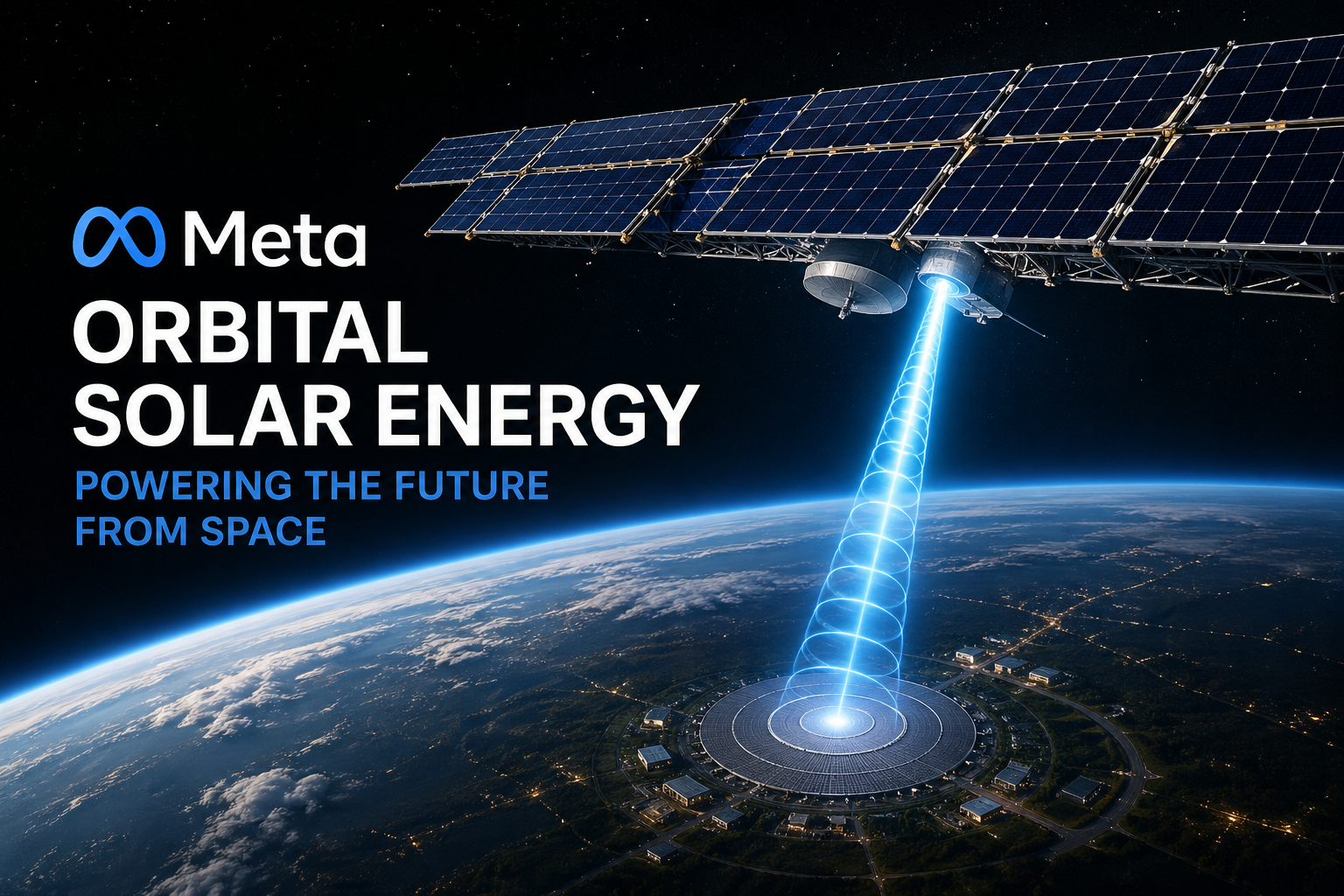
The core principle behind Meta orbital solar energy is relatively straightforward, even if the engineering challenge is significant. Solar panels placed in orbit around Earth can, in theory, collect uninterrupted sunlight without the interference of night cycles, weather conditions, or atmospheric filtering. This continuous exposure allows for far greater energy capture efficiency compared to terrestrial solar installations. The energy would then be transmitted wirelessly, potentially through microwave or laser-based systems, down to receiving stations on Earth where it can be converted into usable electricity. For a company operating vast data centres and AI infrastructure, such as Meta, this concept is being explored as a potential long-term solution to increasing energy demand.
From an SEO and digital infrastructure perspective, Meta Orbital Solar Energy is particularly relevant because it aligns with the rising global pressure on technology companies to decarbonise operations. Competitors in the UK and wider European markets are already investing heavily in renewable energy procurement, carbon-neutral hosting environments, and on-site solar or wind generation. However, these terrestrial solutions are increasingly limited by geography, scalability constraints, and local regulatory pressures. Meta orbital solar energy, although still in its conceptual and early development stages, offers a narrative shift: energy generation that is not constrained by land availability or local climate conditions.
One of the most significant advantages being associated with Meta orbital solar energy is its potential consistency. Unlike Earth-based renewable sources, orbital solar collection could provide near-constant energy input. This is especially important for data centres, which require uninterrupted power to maintain uptime, manage AI workloads, and support global social media platforms. Even minor interruptions in energy supply can result in significant service disruptions or increased operational costs. By exploring this Meta is effectively investigating whether future infrastructure resilience can be achieved beyond Earth’s surface.
However, it is equally important to acknowledge the complexity and challenges that come with Meta orbital solar energy. The cost of launching, maintaining, and repairing orbital infrastructure remains extremely high, even with advancements in reusable rocket technology. There are also unresolved technical challenges around energy transmission efficiency, atmospheric interference, and safety regulations regarding high-energy beams directed toward Earth. These barriers mean that meta-orbital solar energy is not a near-term replacement for existing renewable strategies, but rather a long-term research and development direction that could complement terrestrial solutions in the future.
For businesses monitoring developments in the wider implication is not necessarily immediate adoption, but strategic forecasting. Companies that rely on Meta platforms, advertising systems, or cloud-based infrastructure indirectly benefit from any energy innovation that reduces operational cost pressures or improves sustainability performance. As Meta continues to scale its AI capabilities and virtual environment technologies, the demand for reliable and sustainable energy will only increase. In this context, Meta orbital solar energy becomes less of a speculative idea and more of a strategic hedge against future energy limitations.
The competitive landscape is also important when analysing Meta orbital solar energy. Other global technology companies are exploring similar concepts, including advanced nuclear solutions, hyperscale renewable farms, and experimental space-based energy systems. While Meta is not alone in considering orbital solar collection, its scale and infrastructure footprint mean that even exploratory research in this area has significant market influence. UK competitors ranking highly in search results for energy innovation and tech sustainability topics are already focusing heavily on terrestrial renewable optimisation, which means Meta’s orbital approach creates a distinct differentiation in search visibility and thought leadership positioning.
From an SEO perspective, content surrounding Meta orbital solar energy is currently relatively underdeveloped, which presents a strong opportunity for authoritative websites like fixfb.co.uk to rank highly for emerging queries. As public interest grows around space-based energy systems, early, in-depth content that explains the implications, challenges and strategic relevance will likely outperform superficial coverage. This is particularly true in the UK market, where businesses are actively seeking clarity on how global tech developments will affect advertising platforms, digital infrastructure costs, and long-term sustainability commitments.
Another important dimension of Meta orbital solar energy is its potential environmental impact narrative. If successfully implemented at scale, orbital solar systems could reduce reliance on fossil-fuel-based grid energy and help large technology companies move closer to net-zero commitments. For Meta, which operates under increasing regulatory and public scrutiny regarding environmental performance, this narrative is strategically significant.
Looking ahead, it is likely to remain in the research, feasibility analysis, and pilot development phase for the foreseeable future. However, the fact that it is being publicly discussed at all indicates a broader shift in how major technology companies are thinking about energy independence. Rather than relying solely on national grids and regional renewable markets, the exploration of orbital solutions suggests a long-term vision where energy generation becomes decentralised on a planetary scale.
In conclusion, this represents a forward-looking exploration of how energy, infrastructure, and technology may converge in the coming decades. While still far from commercial reality, it highlights the scale of innovation being considered to support next-generation digital ecosystems. For businesses and SEO strategists tracking developments in Meta and global tech infrastructure, Meta orbital solar energy is a key term to watch, not only for its technological implications but also for its growing relevance in search visibility, sustainability discourse, and competitive digital positioning.