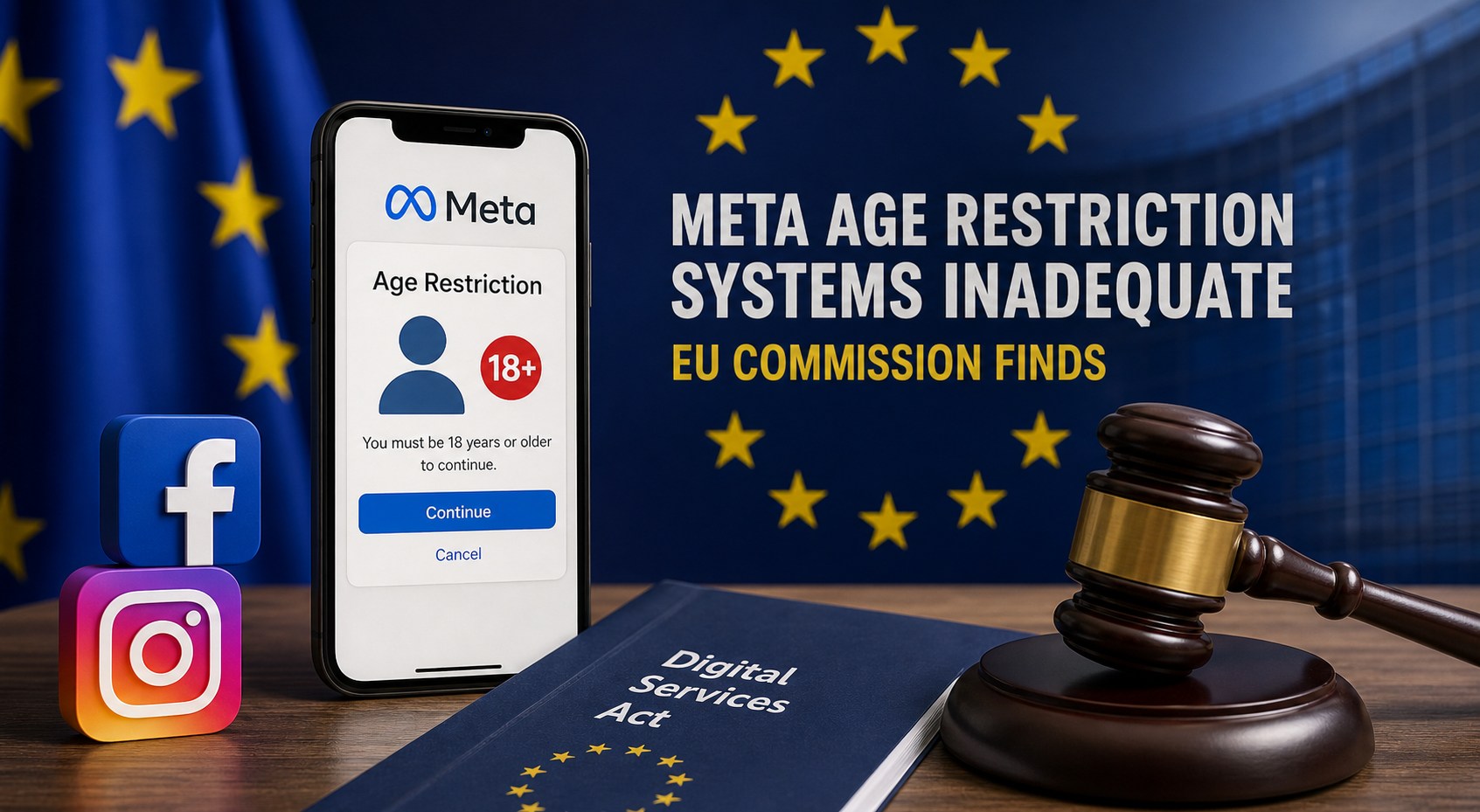
Meta Age Restriction Systems Ruled Inadequate by EU
Why Meta Age Restriction Systems are Failing Compliance Expectations:
Meta age restriction systems have come under significant scrutiny following a decisive assessment by the European Commission, which concluded that the current safeguards implemented across Meta’s platforms are insufficient to properly protect younger users. This is not just another regulatory headline; it marks a clear shift in how digital platforms are expected to handle age verification, user safety, and accountability within the European Union. For business users relying on Facebook and Instagram, the implications of Meta age restriction systems being deemed inadequate are immediate and difficult to ignore.
The European Commission’s findings expose a long-standing issue: the gap between policy and enforcement. While Meta has consistently claimed its systems are robust, using AI detection, reporting tools, and behavioural signals, regulators have found these measures fail to reliably prevent underage users from bypassing restrictions. This raises concerns under the Digital Services Act, which requires large platforms to actively mitigate risks to minors. For businesses, this introduces a layer of uncertainty around the reliability of audience data. The problem is straightforward but serious. Advertising, targeting, and content strategies depend on accurate user information. If Meta age restriction systems allow inaccurate age data, campaigns intended for adults could reach minors. This creates potential reputational risks and compliance issues, particularly for industries like alcohol, finance, and health. Businesses cannot assume the platform is fully filtering audiences as intended, and this changes how risk must be managed.
Meta’s systems are not entirely ineffective, but they are inconsistent. Self-declared age remains a core method, making it easy to bypass restrictions. Although Meta has introduced AI-based age estimation and parental tools, these measures are not yet considered reliable enough by regulators. This inconsistency places businesses in a difficult position, where platform assurances do not fully align with regulatory expectations.
Operationally, the ruling on Meta age restriction systems could lead to significant platform changes. Stricter verification processes may impact how users sign up and engage, while advertising tools could become more restricted. Businesses may face reduced targeting precision or additional compliance steps when running campaigns. While these changes aim to improve safety, they may also reduce efficiency and increase friction in marketing workflows.
There is also a wider trend emerging. The EU’s stance reflects a broader push to hold platforms accountable for user safety, data accuracy, and transparency. This is not an isolated issue but part of increasing regulatory pressure on major tech companies. UK businesses, especially those serving European audiences, must pay attention. Regulatory expectations often extend beyond borders, shaping global standards and influencing how platforms operate worldwide. User trust is another key factor. News that Meta age restriction systems are inadequate may affect how users perceive the platform. Parents, in particular, may become more cautious, potentially impacting user growth and engagement. For businesses, this matters because trust directly influences campaign performance. If users disengage or become sceptical, marketing results will follow.
To manage these risks, businesses should take a more proactive approach. Relying solely on platform safeguards is no longer enough. Reviewing audience settings, applying stricter exclusions, and ensuring content is suitable for a wider audience can help reduce exposure. Monitoring campaigns closely for unexpected engagement patterns is also essential. These steps may not eliminate risk entirely, but they provide greater control. It is also worth considering platform diversification. As scrutiny on Meta age restriction systems increases, alternative platforms may position themselves as safer or more compliant. Businesses should assess whether their current reliance on Meta aligns with their long-term strategy. Diversifying channels is not just about growth; it is also about reducing dependency and managing regulatory risk.
Financial implications cannot be ignored. While fines are typically directed at platforms, the indirect impact on businesses can be significant. Changes to targeting, engagement, or user behaviour can affect return on investment. Reduced efficiency in advertising or shifts in audience trust may require businesses to adjust budgets and expectations.
Technically, improving Meta age restriction systems is not simple. Stronger verification methods, such as ID checks, could improve accuracy but may create user friction and raise privacy concerns. Meta must balance compliance with user experience, and the outcome of this balance will directly affect businesses. A stricter system may mean fewer users but higher data accuracy, changing how campaigns are structured. Looking ahead, further changes to Meta age restriction systems are likely. The European Commission’s position makes it clear that improvements are expected. These may include better verification processes, increased transparency, and stricter enforcement. Businesses that stay informed and adapt early will be better placed to manage these shifts.
In conclusion, the finding that Meta age restriction systems are inadequate is more than a regulatory warning; it is a signal that the digital landscape is changing. Businesses can no longer rely entirely on platform systems to manage compliance and audience accuracy. By understanding the limitations of Meta age restriction systems and adjusting strategies accordingly, businesses can protect themselves, maintain compliance, and continue to operate effectively in an increasingly regulated environment.