Meta AI Ad Connectors Expand Chatbot Integration Capabilities
Meta AI Ad Connectors and the Future of Chatbot Integration for Business Advertising:
Meta AI ad connectors are emerging as a significant development for businesses that rely on automated customer engagement, particularly those who have struggled with the limitations of Meta’s native support systems. The introduction of Meta AI ad connectors marks a shift in how advertising campaigns can interact with external chatbot platforms, allowing businesses to extend conversations beyond the traditional boundaries of Facebook and Instagram messaging. For many business users, especially those frustrated by inconsistent support and limited tooling from Meta, this update represents a more flexible and controllable way to manage customer interactions at scale.
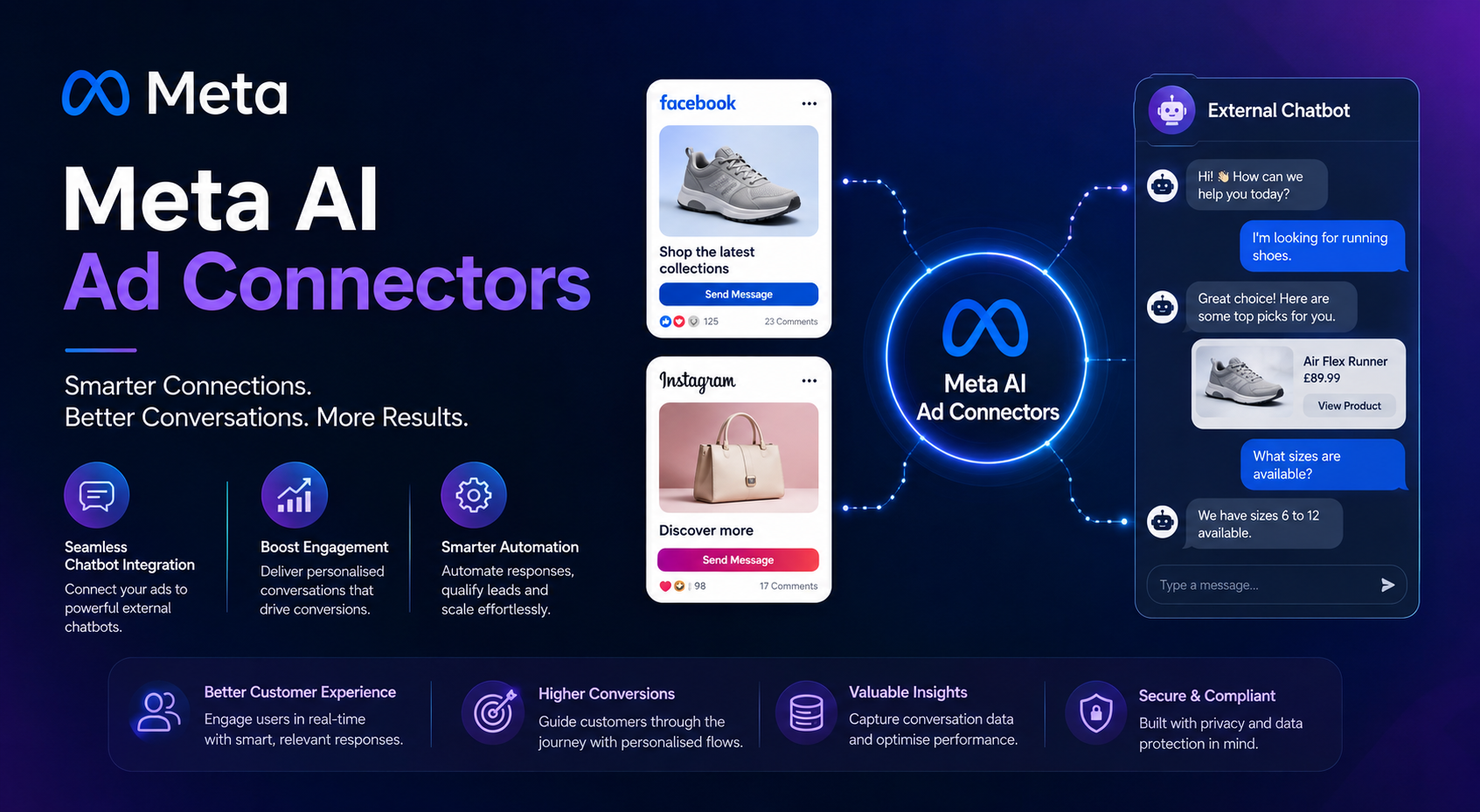
At a practical level, Meta AI ad connectors allow advertisers to link their ad campaigns directly with external chatbot systems. Instead of relying solely on Meta’s built-in messaging features, businesses can now redirect users who engage with ads into more advanced conversational environments powered by third-party AI tools. This creates a smoother transition between advertising and customer interaction, reducing friction and enabling more meaningful engagement. For companies already using chatbot platforms for sales, lead generation, or customer support, Meta AI ad connectors provide a way to unify these systems with advertising activity, creating a more seamless customer journey.
The importance of Meta AI ad connectors becomes clearer when considering how businesses currently interact with Meta’s ecosystem. Many advertisers have long expressed frustration at the lack of responsive support and the limitations of automated tools provided by Meta itself. Issues such as delayed responses, unclear policy enforcement, and restricted messaging flexibility have made it difficult for businesses to scale effectively. Meta AI ad connectors offer a partial workaround to these challenges by giving businesses more autonomy over how conversations are handled once a user engages with an advertisement. Instead of being locked into rigid native flows, businesses can design their own conversational logic using external systems.
One of the most powerful aspects of Meta AI ad connectors is the ability to create highly personalised customer journeys. Traditional ad-to-message flows are often linear and restrictive, but when integrated with external chatbot platforms, businesses can build dynamic conversations that respond intelligently to user input. This means that a customer clicking on an advert for a product or service can immediately enter a tailored dialogue that adjusts based on their needs, preferences, and behaviour. In industries such as e-commerce, travel, and financial services, where customer intent can vary widely, this level of flexibility is particularly valuable.
From an operational perspective, Meta AI ad connectors also address a major challenge faced by growing businesses: scalability. As advertising campaigns increase in reach, so too does the volume of incoming messages. Without automation, this can quickly overwhelm support teams and lead to missed opportunities. By routing conversations through external chatbot systems, businesses can handle thousands of simultaneous interactions without sacrificing quality or response speed. This not only improves efficiency but also reduces the need for large manual support teams, which can be costly and difficult to maintain.
Another key advantage of Meta AI ad connectors lies in data integration and performance insights. When conversations are managed through external chatbot platforms, businesses gain access to richer datasets that can be used to refine marketing strategies. This includes information on user behaviour, common queries, drop-off points, and conversion pathways. By analysing this data, businesses can optimise their advertising campaigns more effectively, adjusting messaging, targeting, and flow structures based on real user interactions. In a competitive digital advertising landscape, this level of insight can make a significant difference in overall performance.
However, while Meta AI ad connectors offer clear benefits, they also introduce new complexities that businesses must carefully manage. Integration is not always straightforward and often requires technical setup between Meta’s advertising platform and external chatbot providers. This can involve API configuration, workflow mapping, and ongoing maintenance to ensure everything functions correctly. For smaller businesses or those without dedicated technical teams, this may present a barrier to entry. As a result, many organisations may need to rely on third-party developers or specialist chatbot providers to implement these systems effectively.
Security and compliance are also critical considerations when using Meta AI ad connectors. Because customer conversations may involve sensitive data, businesses must ensure that all integrations comply with data protection regulations such as GDPR. This includes securing data transmission, managing user consent appropriately, and maintaining transparency about how information is processed and stored. Failure to address these requirements can result in both legal and reputational risks, particularly for businesses operating in regulated industries.
Despite these challenges, Meta AI ad connectors align closely with broader trends in digital marketing, particularly the rise of conversational commerce. Consumers are increasingly comfortable interacting with businesses through messaging interfaces rather than traditional web forms or static landing pages. By connecting advertising directly to chatbot experiences, businesses can meet users in the environments they already prefer, creating faster and more natural interactions. This shift is not just about convenience; it also has a direct impact on conversion rates, as users are more likely to engage when responses are immediate and relevant.
For businesses considering the adoption of Meta AI ad connectors, the most effective approach is to start with a clear use case. This might involve automating lead qualification, handling frequently asked questions, or guiding users through product discovery. Once a specific objective is identified, businesses can then select a compatible chatbot platform and design the integration around that goal. Running pilot campaigns is also recommended, as this allows teams to test performance, identify issues, and refine workflows before scaling across larger advertising efforts.
Ultimately, Meta AI ad connectors represent an important evolution in how businesses can connect advertising with conversational AI. While they do not eliminate the challenges associated with Meta’s broader ecosystem, they do provide a powerful alternative for organisations seeking greater control, scalability, and personalisation in their customer engagement strategies. For businesses that have previously struggled with limited support or rigid messaging tools, this development offers a practical way to regain control over how customer interactions are managed.
In conclusion, this is reshaping the relationship between advertising and customer communication by enabling seamless integration with external chatbot systems. This creates opportunities for more efficient automation, deeper personalisation, and improved data-driven decision-making. Although implementation requires careful planning and technical consideration, the long-term benefits for businesses willing to adopt the technology are substantial. As conversational experiences continue to dominate digital engagement, Meta AI ad connectors are likely to become an increasingly important tool for businesses looking to stay competitive in an evolving advertising landscape.