Social Media Drives Consumer Discovery, Per Meta: What It Means for UK Brands
Why Social Media Drives Consumer Discovery, Per Meta
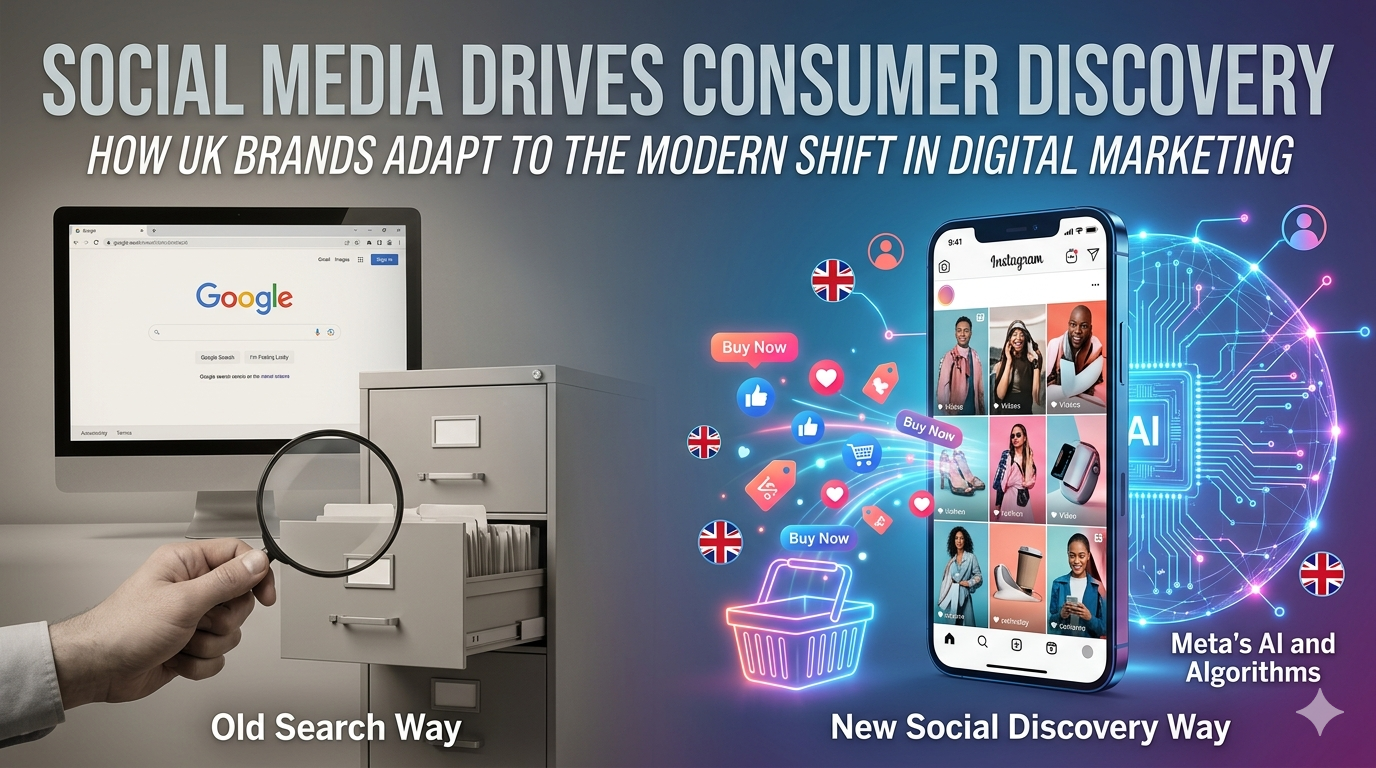
Social media drives consumer discovery, per Meta, completely altering how British buyers choose what to purchase online. In a comprehensive three-part research series published by the tech giant, data reveals a monumental shift away from traditional search engines toward social ecosystems. For UK business owners and digital marketers, this insight proves that relying solely on conventional Google SEO is no longer sufficient to capture modern intent.
The way British consumers interact with brands has undergone a profound structural transformation over the last few years. According to Meta’s 16-page report, Google searches per user have declined noticeably as people transition to passive, entertainment-led browsing. Shoppers are increasingly relying on in-stream recommendations, short-form video, and creator content to uncover products they did not even know they were looking for.
Understanding this commercial evolution is critical for any brand trying to scale its digital marketing footprint. Meta asserts that consumers do not think in channels; they think in questions, but their destination for answers has changed. This leaves traditional marketers, who are still budgeting for an older era of text-based intent, highly vulnerable to losing market share.
To understand why this shift is happening, businesses must look closely at modern user behaviour across Facebook and Instagram. Historically, consumer discovery began with a clear intent typed into a search bar. Today, discovery happens mid-scroll, fueled by algorithmic engagement and highly immersive formats.
Meta’s report highlights that social platforms have successfully blended entertainment with utility. Users log on to be entertained via Reels, but they walk away having discovered a new British boutique or direct-to-consumer brand. The content itself has become the primary destination, meaning the traditional path to purchase has been compressed.
This represents a major opportunity for UK businesses willing to pivot their organic and paid social strategies. Instead of waiting for a prospect to search for a specific product, brands can actively spark demand. By deploying targeted content that mirrors authentic user-generated material, companies can effortlessly enter the consumer’s consideration mindset.
The Role of Artificial Intelligence in Social Search
Maximising Connections Through Meta’s AI Engine
Artificial Intelligence is the underlying engine driving this massive transition toward social discovery. Meta has heavily invested in its Generative Ads Recommendation Model (GEM) to deeply analyze organic engagement signals and longer user behaviour sequences. This allows the algorithm to predict exactly what kind of product a user might want to see next.
For advertisers in the United Kingdom, this means that machine learning is doing the heavy lifting of audience targeting. Meta’s AI systems look at what individuals watch, like, and comment on to serve highly relevant, tailored ads. Rather than guessing demographic buckets, brands now feed the algorithm high-quality creative assets and allow AI to find the buyer.
Overcoming Platform Instability and Content Saturation
Despite these technological advancements, UK marketers frequently express frustration over platform instability and sudden algorithmic updates. Many brands complain of “misunderstood signals” where ad performance fluctuates without warning. This makes it difficult to maintain a stable cost per acquisition (CPA) on standard campaigns.
To counteract this volatility, companies must build diversified, resilient content ecosystems. Relying on a single ad format or a static creative strategy leaves your business vulnerable to system fluctuations. Diversifying into Reels, carousels, and conversational formats provides Meta’s AI with the variety of data points it needs to optimise properly.
Adapting Your UK Marketing Strategy to the Discovery Shift
Optimising for Zero-Click Search Experiences
Social media drives consumer discovery, per Meta. The rise of “zero-click search” has accelerated. Consumers increasingly prefer to find product reviews, tutorials, and prices directly inside Instagram or Facebook without navigating away. This means your profile, shop tab, and direct messages must be fully optimised to close the sales loop.
UK retailers must ensure their product feeds are flawlessly integrated with Meta Commerce Manager. If a consumer discovers your item on their feed, they should be able to view pricing and specifications instantly. Removing friction at the exact moment of discovery is what separates high-performing brands from those suffering from high drop-off rates.
Aligning Creative Asset Portfolios with AI Requirements
To succeed under this new paradigm, your creative output must shift from overly polished commercials to raw, human-centric storytelling. Data indicates that authentic, creator-led vertical videos deliver significantly higher engagement rates across the UK market. Audiences want to see real people demonstrating products in everyday British environments.
Prioritise Hook Variation: Test three distinct video hooks within the first 3 seconds of your Reels to capture shifting attention spans.
Leverage Advantage+ Placements: Allow Meta’s AI to distribute your creative assets across all available network surfaces for optimal cost efficiency.
Embed Structured Social SEO: Utilise descriptive keywords in your captions and alt-text to help Meta’s discovery engine categorise your products accurately.
Navigating UK Regulatory Compliance and Consent Models
Social media drives consumer discovery, per Meta. Operating within the UK digital landscape requires careful attention to shifting data privacy and compliance frameworks. The Information Commissioner’s Office (ICO) recently formalised data usage rules, requiring Meta to implement clearer “consent or pay” models for British users. This directly impacts how first-party and third-party data can be gathered for ad targeting.
With tighter restrictions on tracking, building an organic presence and capturing voluntary customer signals is more vital than ever. Utilising interactive lead forms, click-to-message ads, and engaged community groups allows brands to build compliant, first-party customer lists. Navigating these regulatory boundaries carefully ensures long-term business continuity without sacrificing marketing reach.
If your business is struggling to maintain consistent returns amid changing privacy laws and platform updates, expert help is available. Partnering with a specialised consultancy can fix account disruptions, realign your pixel data, and restore stability to your ad spend.
Future-Proofing Your Business for Social Discovery
The evidence presented by Meta makes it clear that the digital discovery engine has fundamentally evolved. Brands that refuse to adapt to social-first search risk becoming invisible to the next generation of UK consumers. By embracing AI-driven targeting and authentic short-form video, you position your business exactly where your audience is looking.
Transitioning your marketing framework to support this shift requires technical precision, robust account health, and strategic asset allocation. If you are facing technical tracking challenges or need assistance setting up an optimised Meta infrastructure, explore our comprehensive technical resolution services at Fixfb.co.uk to ensure your campaigns run smoothly.