Navigating the EU Commission’s Preliminary Findings That Meta Apps Are Addictive: A Guide for UK Businesses
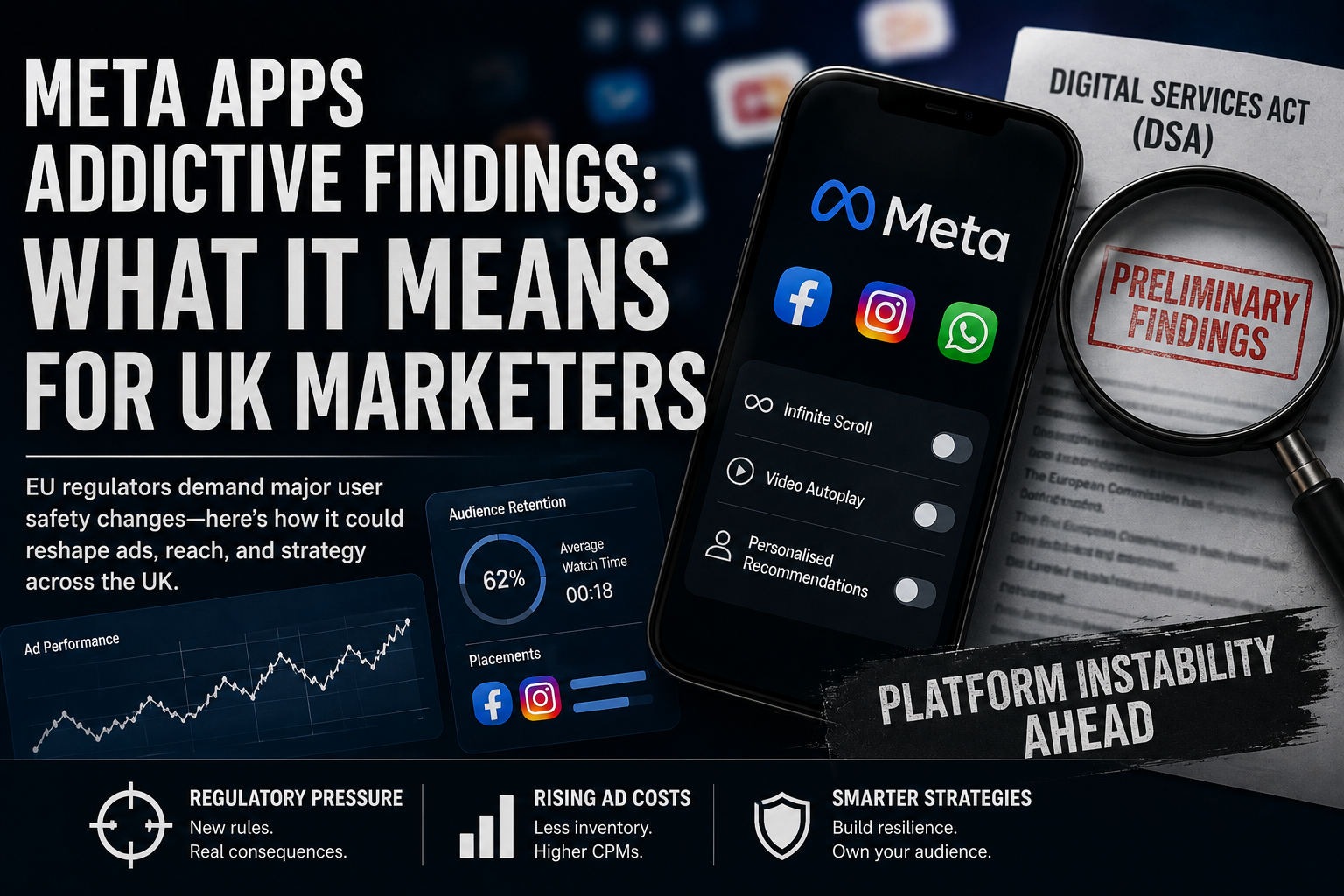
The European Commission has preliminarily found Meta in breach of the Digital Services Act (DSA) over user safety, confirming that Meta apps addictive findings could fundamentally reshape paid social media strategies across Europe and the UK. Issued in July 2026, these findings directly target user engagement mechanics—specifically infinite scroll, video autoplay, push notifications, and highly personalised recommender systems. For UK business owners and digital marketers, this regulatory friction highlights growing platform instability and signals that the era of friction-free, algorithm-driven user attention is undergoing intense statutory scrutiny.
While the UK operates outside the direct jurisdiction of the EU Commission, Meta standardises its core infrastructure and engineering updates globally. If Meta is forced to dismantle or alter these engagement hooks, the cascading effects on organic reach, ad delivery, and overall consumer behaviour will be felt intensely by British brands. Understanding these preliminary findings is no longer optional; it is a critical requirement for de-risking your digital marketing architecture against sudden algorithmic shifts.
How the Meta Apps Addictive Findings Impact UK Digital Marketers
The European Commission’s investigation focuses heavily on how Meta platforms impact the physical and mental well-being of users, particularly minors and vulnerable adults. According to Brussels regulators, Meta’s engineering deliberately shifts the human brain into an “autopilot mode,” driving compulsive platform use through uninterrupted content feeds.
The primary product mechanics under review include:
Infinite Scroll: The seamless, bottomless feed that removes natural psychological stopping points.
Video Autoplay: The automatic playback of Reels and video content that lowers the friction of consumption.
Engagement-Oriented Recommender Systems: Algorithms explicitly optimised to maximise time-on-site rather than user intent.
For years, digital marketers have relied on these exact mechanics to keep target audiences glued to their screens, inadvertently benefiting from highly concentrated ad-impression frequencies. The regulatory demand to change these default behaviours means platforms may soon look, feel, and perform quite differently.
How the Meta Apps Addictive Findings Create Platform Instability for UK Brands
When regulatory bodies squeeze major tech platforms, the immediate byproduct is platform instability. Meta is currently facing potential non-compliance fines capped at 6% of its total worldwide annual turnover—running into billions of pounds—if these preliminary findings are confirmed. To mitigate this legal and financial exposure, Meta is highly likely to adjust its algorithmic delivery systems globally.
[Insert image showing Facebook Ad Manager settings highlighting audience retention and platform delivery metrics here]
We have already observed how minor tweaks to user interfaces create volatile spikes in Cost Per Mille (CPM) and erratic conversions in Meta Ads Manager. If the EU forces Meta to disable autoplay or infinite scroll by default, user session lengths will decrease. Fewer minutes spent on Instagram means a contraction in available ad inventory, naturally driving up ad costs for competitive UK e-commerce and B2B sectors.
Structural Changes Demanded by Regulators After Meta Apps Addictive Findings
The European Commission has explicitly stated that Meta’s existing risk-mitigation measures, such as basic screen-time limits and parental dashboards, are easily bypassed and insufficient. Regulators are demanding structural, “safety-by-design” changes to the user interface.
Mandatory Screen-Time Breaks and Default Disabling
Regulators want key engagement features disabled by default. Instead of opting out of infinite scroll or autoplay, users would actively have to opt-in. This structural inversion will fundamentally alter content consumption habits, breaking the passive scrolling patterns that top-of-funnel awareness campaigns rely upon.
Shifting Recommender Systems Away From Engagement
Perhaps the most disruptive demand is the re-engineering of the recommendation algorithm. The EU is pushing for a system that is less engagement-oriented and more focused on explicit user control. When user feeds stop prioritising sensational, high-dopamine triggers, the virality metrics of organic content will shift predictably toward intentional, utility-driven media.
Proactive Content Strategies Amid Meta Platform Instability
Relying solely on a single platform’s algorithmic stability is a systemic risk for any British enterprise. As these legal battles unfold throughout 2026, smart marketers are diversifying their communication pipelines to safeguard their customer acquisition funnels in light of the Meta apps addictive findings, shaking up the market
| Risk Area | Algorithmic Impact | Fixfb Strategic Solution |
| Declining Ad Inventory | Shorter sessions lead to higher CPMs and competitive bidding wars. | Optimise first-party data capture and invest heavily in high-intent creative. |
| Reduced Organic Virality | Feed changes limit algorithmic content pushing. | Focus on brand utility, direct-to-consumer search, and community building. |
| Audience Fragmentation | Users migrating to less-regulated or alternative niches. | Expand omnichannel attribution across alternative native networks. |
To counter this platform instability, brands must pivot from “interruption marketing” to “destination marketing.” Your creative content must possess enough standalone value that a consumer will intentionally seek it out, even if a platform’s notification loop or infinite feed is restricted.
Re-optimising Your Paid Social Framework for a Compliance-First Era
If your digital marketing model relies heavily on low-friction engagement cues, it is time to audit your cross-channel framework. Marketers must learn to navigate these misunderstood signals from regulators and platforms alike by building more resilient, consumer-centric campaigns.
Prioritise Zero-Party and First-Party Data: Do not trust the platform to hold your audience forever. Use Meta ads to actively drive prospects to owned assets, such as permission-based email marketing lists and native SMS programmes.
Focus on Intent-Driven Creative: If autoplay is turned off, your static imagery and initial video frames must work twice as hard. Design assets that demand an active click rather than relying on passive, structural video views.
Broaden the Attribution Window: Accept that user paths to purchase will become less linear if platform time drops. Utilise robust, third-party marketing attribution software to measure the true holistic impact of your digital spend across multiple channels.