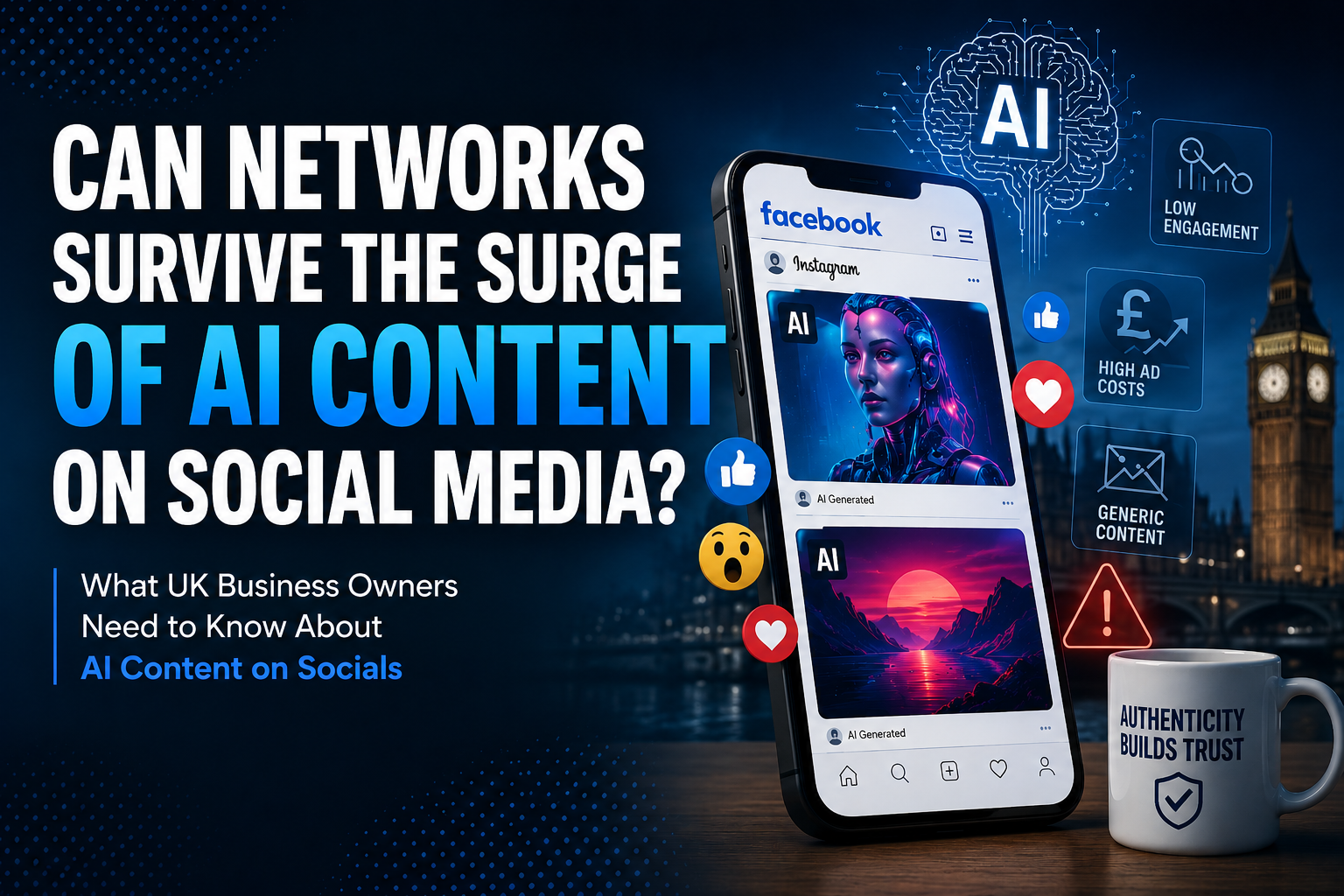
Can Social Media Platforms Survive AI Content on Social Media?
As generative technology accelerates, UK business owners are asking a vital question: can networks withstand the sheer volume of AI content on social media? Every day, millions of automated posts, synthetic images, and synthetic videos are published across Facebook and Instagram. For digital marketers relying on Meta to drive revenue, this influx of low-quality volume creates noise and inflates advertising costs.
Understanding how Meta’s algorithms adapt to synthetic media is essential for keeping your brand visible online.
The Rise of AI Content on Feeds
Generative tools have drastically lowered the cost of producing graphics, video scripts, and ad copy. While this efficiency helps small teams scale creative assets, the sudden surge of AI content on social media creates severe consumer fatigue.
User feeds are filled with repetitive, synthetic posts that suffer from lower engagement rates than human-led content.
Key Takeaway: High volume no longer guarantees visibility on Meta; authentic engagement metrics carry significantly more weight in current delivery algorithms.
When platforms become saturated with generic material, user dwell time decreases, and audience trust erodes.
For UK businesses, maintaining a distinct voice is harder when competing against millions of daily automated variations.
How Meta’s Algorithms Treat AI Content on Socials
Meta’s feed distribution systems are built to reward genuine user engagement, meaningful interactions, and original assets. To combat spam, Meta deploys automated classifiers designed to detect synthetic assets and synthetic text structures. While Meta does not outright ban AI content on social media, posts flagged as low-value receive reduced organic reach. Adverts that rely entirely on generic, low-effort creative assets suffer from higher CPMs (Cost Per Mille) and declining click-through rates.
The algorithm actively penalises accounts that display automated spam behaviour or push repetitive messaging.
Why Organic Trust Matters for UK Business Owners
UK consumers have developed a sharp eye for synthetic media, sponsored posts, and automated commercial interactions. Audience sentiment studies consistently demonstrate that British buyers place a high premium on transparency, proof, and localized authenticity.
Relying strictly on generic AI content on social media risks damaging your reputation and lowering conversion performance.
Decreased Audience Retention: Generic visuals result in users scrolling past within split seconds.
Reduced Algorithmic Priority: Low comment activity directly signals to Meta that your post is irrelevant.
Wasted Ad Spend: Automated creative assets often fail Meta’s ad auction quality checks, increasing costs.
To maintain strong account health on Facebook and Instagram, brands must balance automated scaling with authentic connection.
Strategies to Filter AI Content on Social Media Out of Your Strategy
Navigating this changing landscape requires an intentional focus on quality over sheer production output. Generative technology should serve as an operational assistant for research or editing, rather than replacing your core strategy.
Here are core actions UK marketing teams should implement immediately:
Prioritise Original Video Assets: Produce raw, human-led video formats such as behind-the-scenes reels and client testimonials.
Incorporate UK-Specific Context: Frame your messaging around real UK market trends, local stories, and distinct regional insights.
Audit Meta Ad Creative: Test user-generated style content against synthetic variations to measure cost-per-acquisition differences.
Strengthen Community Management: Respond promptly and thoughtfully to comments to build positive algorithmic signals.
Implementing these adjustments ensures your campaigns stay competitive while maintaining a sustainable return on ad spend.
Will Networks Survive the Surge of AI Content on Social Media?
Social networks will undoubtedly survive this technological shift, but the nature of organic reach is fundamentally changing. Meta is investing heavily in detection systems, media labeling tools, and creator verification measures to preserve feed quality. Platforms that successfully filter out low-quality AI content on social media will remain essential hubs for commercial growth. For business owners, the winning approach isn’t avoiding new tools, but using them to support genuine human expertise. By combining efficient internal workflows with authentic brand storytelling, your business can comfortably outperform generic competitors.