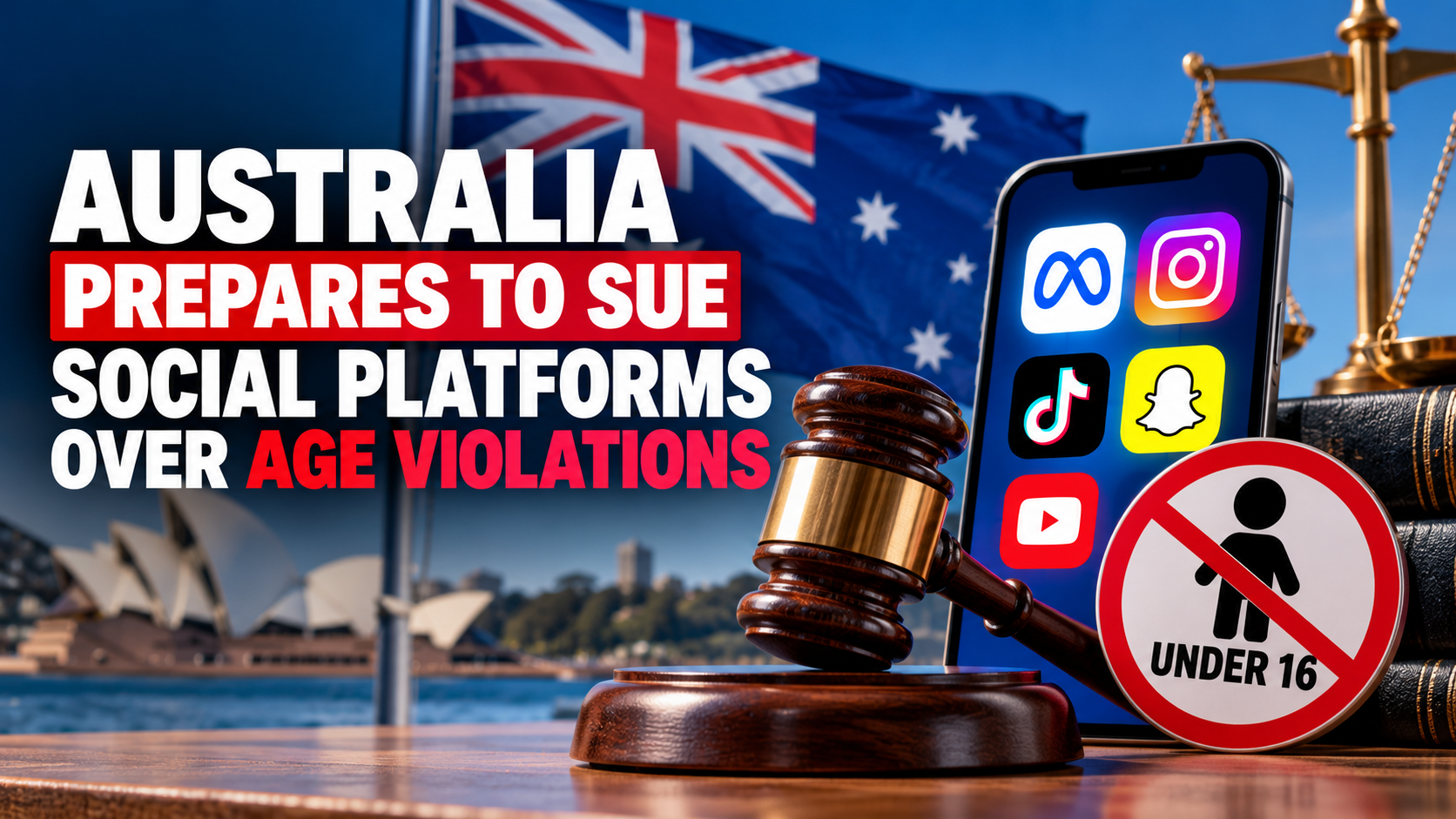
Australia Prepares to Sue Social Platforms Over Age Violations: What UK Businesses Need to Know
Australia prepares to sue social platforms over alleged age restriction violations, increasing pressure on Meta, TikTok, Snapchat and YouTube to demonstrate compliance with the country’s online safety laws.
The development follows Australia’s introduction of strict social media age restrictions designed to prevent children under 16 from holding accounts on designated platforms.
For UK business owners and digital marketers, the potential legal action raises important questions about age verification, advertising regulations and the future of social media compliance.
As governments strengthen online safety enforcement, understanding these developments can help businesses prepare for possible changes to Facebook, Instagram and other digital platforms.
Why Australia Prepares to Sue Social Platforms Over Age Violations
Australia introduced its social media minimum-age restrictions on 10 December 2025, requiring designated platforms to take reasonable steps to prevent children under 16 from holding accounts.
The legislation places responsibility on social media companies rather than children or their parents.
However, enforcing age restrictions across platforms with millions of users presents significant technical and operational challenges.
Australian authorities have investigated whether major platforms are doing enough to prevent underage users from maintaining accounts.
Recent reporting indicates that regulators are considering legal action against companies suspected of failing to meet these requirements.
Importantly, preparing legal proceedings does not establish that a company has breached the law.
Which Companies Could Face Legal Action?
The reported enforcement action involves several major technology companies operating popular social media services.
These include:
- Meta: Owner of Facebook and Instagram.
- TikTok: A leading short-form video platform.
- Snapchat: A messaging and content-sharing service.
- YouTube: Google’s video-sharing platform.
Other services, including Threads, X, Reddit and Twitch, are also covered by Australia’s minimum-age framework.
The potential involvement of Meta makes this development particularly relevant to businesses that depend on Facebook and Instagram for customer engagement and advertising.
Australia’s Social Media Age Restrictions Explained
Australia’s legislation requires affected platforms to take reasonable steps to prevent users under 16 who ordinarily reside in Australia from creating or maintaining accounts.
The restrictions do not automatically prevent children from viewing every publicly accessible webpage or video.
Certain content may remain available without requiring users to create an account.
How Does Age Verification Work?
Platforms may use different methods to assess whether users meet the minimum-age requirement.
These can include age-estimation technology, existing account information and other appropriate verification signals.
The legislation does not require every user to provide government-issued identification.
Platforms must also consider privacy protections when processing personal information for age assurance.
The key regulatory question is whether their systems take reasonable steps to prevent underage account access.
Australia Prepares to Sue Social Platforms as Penalties Increase
As Australia prepares to sue social platforms, recent legislative changes have strengthened the regulator’s ability to investigate potential violations.
In September 2026, Australian lawmakers expanded the eSafety Commissioner’s powers to obtain information and evidence during compliance investigations.
The changes also increased the maximum court-imposed civil penalty for corporate non-compliance to A$109.2 million.
These penalties are not automatic.
A court must determine whether a company has failed to meet its legal obligations before imposing a penalty.
The increased financial exposure demonstrates how seriously Australian authorities are treating online safety compliance.
Why Meta’s Facebook and Instagram Face Increased Scrutiny
Meta operates two of the world’s most influential social media platforms, making Facebook and Instagram central to the age restriction debate.
In March 2026, Australia’s eSafety Commissioner identified Facebook, Instagram, Snapchat, TikTok and YouTube as platforms under investigation.
The regulator raised concerns about continued underage access despite efforts to remove accounts.
Why Removing Underage Accounts Is Not Enough
Removing an account does not necessarily prevent someone from creating another profile.
Platforms must consider whether their systems can identify attempts to bypass restrictions and respond appropriately.
However, age-assurance technology can also produce incorrect results, potentially restricting legitimate users.
This creates challenges around accuracy, privacy and account accessibility.
What Australia’s Social Platform Restrictions Mean for UK Businesses
Although Australia’s legislation does not directly introduce equivalent age restrictions in the United Kingdom, it highlights a growing international focus on online safety.
For businesses relying on Meta’s advertising ecosystem, regulatory developments could influence how platforms manage younger audiences.
1. Changes to Advertising and Audience Targeting
Businesses targeting younger audiences should review their advertising strategies and platform policies.
Age restrictions may affect audience availability and campaign reach in countries where stricter requirements apply.
Advertisers should avoid attempting to bypass platform safeguards or relying on inaccurate age information.
2. Greater Focus on Account Verification
Stronger age-assurance requirements may introduce additional verification processes for some users.
Businesses should monitor official Meta announcements rather than assuming Australian rules will automatically apply to UK accounts.
Maintaining accurate business information and secure account access remains essential.
3. Potential Changes to Customer Engagement
Businesses serving younger customers should consider alternative communication channels.
Websites, email and other appropriate platforms can help maintain communication when social media access changes.
Diversifying communication channels also reduces dependence on individual social networks.
How UK Businesses Can Prepare as Australia Prepares to Sue Social Platforms
As Australia prepares to sue social platforms, UK businesses can take practical steps to strengthen their social media compliance strategies.
Although immediate changes may not be necessary, reviewing existing practices can reduce future disruption.
Consider these recommendations:
- Review audience demographics: Understand the age groups engaging with your content and advertisements.
- Check Meta advertising policies: Ensure campaigns follow current requirements for younger audiences.
- Monitor regulatory developments: Follow announcements from Ofcom and Australia’s eSafety Commissioner.
- Diversify marketing channels: Avoid depending entirely on Facebook or Instagram.
- Protect customer information: Apply appropriate privacy safeguards when collecting personal data.
- Document platform issues: Keep records of account restrictions, verification problems and support requests.
These measures can help businesses maintain responsible marketing practices while preparing for regulatory changes.
Could Australia’s Age Restrictions Influence UK Online Safety Laws?
The United Kingdom already regulates online services through the Online Safety Act 2023.
Ofcom oversees relevant duties relating to illegal content and children’s online safety.
However, the UK’s framework differs from Australia’s general restrictions on social media accounts for children under 16.
UK businesses should therefore avoid assuming that Australia’s requirements automatically apply to their customers.
Nevertheless, developments overseas may influence future discussions about age assurance, platform accountability and children’s online safety.
For digital marketers, staying informed is more useful than reacting to speculation.
Why Australia Prepares to Sue Social Platforms Matters for Digital Marketing
The potential legal proceedings demonstrate that online safety regulations are becoming a significant operational consideration for technology companies.
Social media platforms must balance user accessibility, privacy protections and regulatory compliance.
For businesses, changes to these systems could eventually affect advertising reach, account verification and audience engagement.
However, the extent of any future impact on UK businesses remains uncertain.
The most effective response is to maintain flexible marketing strategies and follow verified platform announcements.
Conclusion: Australia Prepares to Sue Social Platforms Over Age Violations
As Australia prepares to sue social platforms over alleged age restriction violations, the development highlights increasing pressure on technology companies to demonstrate effective online safety compliance.
Meta, TikTok, Snapchat and YouTube face scrutiny over whether their systems meet Australia’s minimum-age requirements.
For UK businesses, the immediate priority is understanding how evolving regulations could influence social media advertising and customer engagement.
Businesses should review their existing practices, monitor official announcements and avoid relying entirely on individual platforms.
Preparing for regulatory changes can help organisations maintain compliant, accessible and effective digital marketing strategies.
Stay Updated on Meta and Social Media Regulations
Online safety regulations continue to evolve, creating new challenges for businesses using Facebook, Instagram and other platforms.
Visit Fixfb.co.uk for practical guidance on Meta updates, digital marketing and social media compliance.
Stay informed, review your social media strategy and prepare your business for future platform changes.