
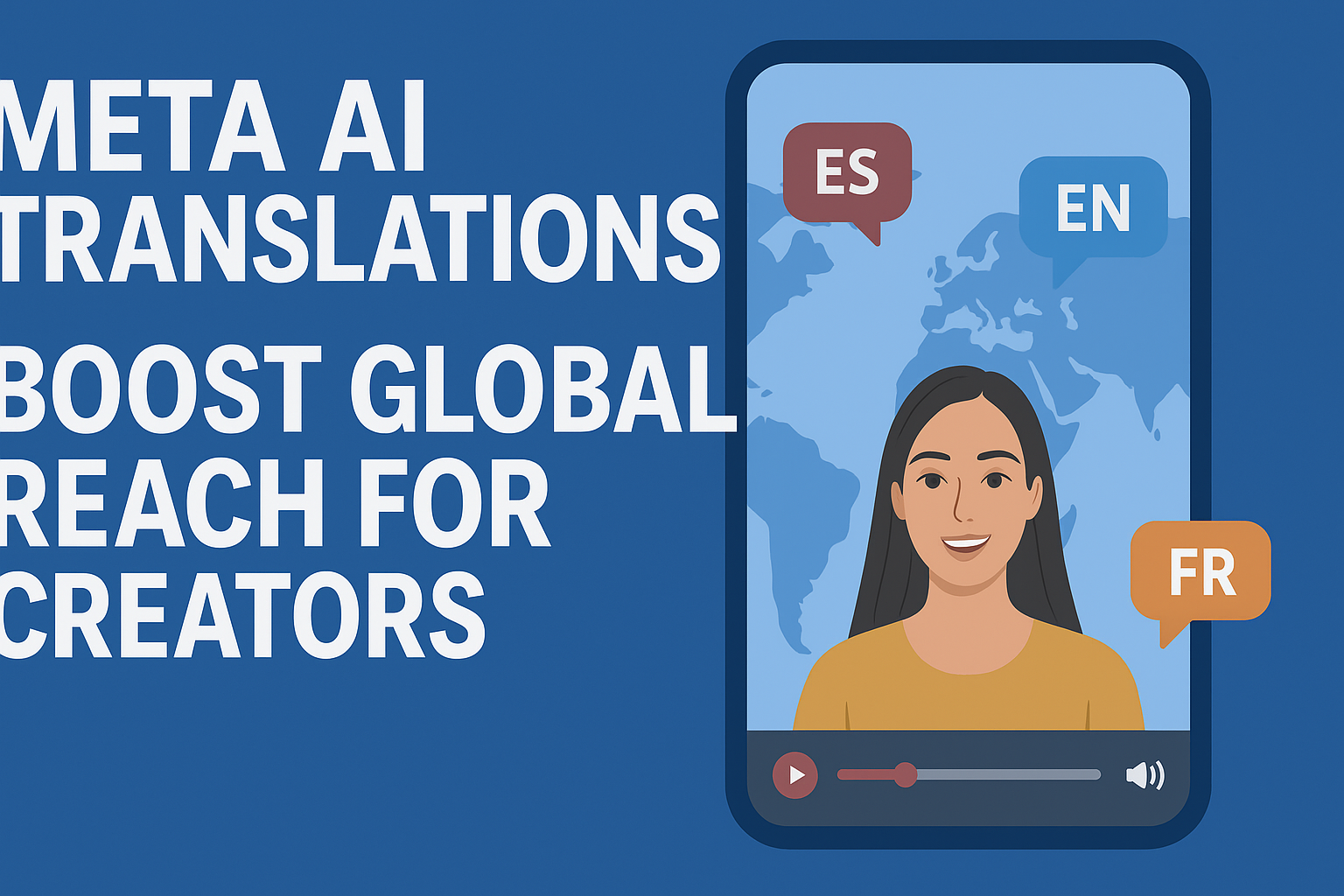
Meta AI Translations Boost Global Reach for Creators
Meta has announced the rollout of a new tool designed to help creators and businesses connect with audiences across language barriers. Known as Meta AI Translations, the technology allows video content, particularly Reels, to be dubbed into different languages with an authenticity that goes far beyond traditional subtitles. Unlike standard translations, it generates a translated voice and even offers lip synchronisation, delivering a far more natural experience for viewers. For businesses looking to expand their global presence through digital content, this development represents a major step forward in accessibility and engagement.
The need for tools like Meta AI Translations has grown as video continues to dominate online communication. Businesses and creators who rely heavily on platforms such as Reels, Instagram, and Facebook face the challenge of engaging international audiences. Subtitles have long been the go-to solution, but they often disrupt the viewing experience, particularly on small screens. Meta’s AI-driven dubbing addresses this problem by offering translated speech in a natural voice that aligns with the original, making the experience more immersive.
The first languages supported are English and Spanish, two of the most widely spoken in the world. This is a strategic choice, given the vast number of users across North America, Latin America, and Europe who engage with Meta’s platforms daily. By removing language as a barrier, creators and businesses can now expand their reach without relying on costly professional dubbing services or extra production resources. This opens opportunities for small businesses and independent creators who may not have had the means to globalise their content.
The optional lip-synchronisation elevates the technology beyond simple audio replacement. Traditional dubbing often suffers from mismatched lip movements, which can make the content feel unnatural. Meta’s AI attempts to solve this by adjusting the visual output so lip movements correspond with the dubbed audio. Although still in its early stages, it demonstrates Meta’s commitment to using AI not only for convenience but also for improving the quality of digital experiences. For businesses, this means producing content that feels more professional, which can help build stronger relationships with international audiences.
The marketing and advertising implications are significant. A brand that once limited content to an English-speaking audience can now deliver campaigns to Spanish-speaking users without diluting the message. This could result in higher engagement rates, stronger brand recognition, and better sales conversions in new markets. Likewise, Spanish-speaking businesses gain a more direct way to reach English-speaking audiences. The ability to cross language barriers effortlessly fosters inclusivity and expands customer bases in both directions.
However, the use of artificial intelligence in translations does raise concerns about accuracy and cultural sensitivity. Automated systems have often struggled with nuance, idioms, and tone, all of which are vital for authenticity. Meta has trained its models to preserve meaning as accurately as possible, but businesses may still need to review translated content carefully to ensure it aligns with their brand and avoids misinterpretation. At present, Meta AI Translations should be seen as a foundation that saves time and resources, while still benefiting from human oversight when necessary.
Privacy and data usage also come into focus. As with any AI tool, questions remain about how voices, videos, and personal data are processed and stored. Meta has stated that the technology is being developed with compliance in mind, but businesses in regulated industries will need to keep an eye on future developments. As global authorities tighten rules around AI and data security, companies adopting these tools will have to remain cautious.
Looking ahead, it seems likely that Meta AI Translations will expand beyond English and Spanish to cover more global languages. This would align with Meta’s broader goal of connecting people worldwide. For businesses, the expansion could mark the start of a new era in digital communication where video content becomes universally accessible, regardless of the creator’s native language.
For business users, the key advantage lies in lowering barriers to entry in international markets. Instead of allocating large budgets to additional production teams, companies can now use AI to adapt existing content for new audiences with minimal cost. This democratises access to global reach, once available only to major corporations, and encourages smaller businesses to think more globally in their strategies.
In conclusion, Meta AI Translations is more than just another feature it reflects a shift towards using artificial intelligence to make digital content more inclusive, authentic, and engaging. By offering dubbed Reels with optional lip-synchronisation, Meta has created a tool that enhances opportunities for global growth. While challenges around accuracy and privacy remain, the benefits are clear. Businesses and creators now have the means to connect with audiences in new markets, strengthen their brand identity across languages, and unlock opportunities that were previously beyond their reach. For those aiming to stay competitive in today’s digital landscape, embracing Meta AI Translations may prove to be an essential step.


